Gender in Ancient Egyptian Art
FIRST THINGS FIRST . . . .
This lesson plan introduces students to the visual representation of gender dynamics in ancient Egypt, through the lens of artistic conventions, visual symbolism, and social identity. By providing examples that focus on continuing, while highlighting variation in how gender was depicted, this lesson will give students the tools and framework to analyze these images within the broader context of Egyptian religion and society.
The goals of this lesson plan are to:
- Familiarize students with the artistic canon of ancient Egypt.
- Investigate how visual conventions communicated gender and power.
- Analyze examples using art historical methods where gender norms were both reinforced and challenged.
- Provide students with clear visual examples from ancient Egypt to bring into follow-up discussions provided by their instructor.
Learning Objectives:
Topics in this lesson plan can be incorporated into broader Art History I and Western Civilization I undergraduate courses, or instructors may include these discussions into thematic courses. Through the incorporation of this introductory lesson plan, students will be able to:
- Identify typical artistic conventions using art historical terminology used in the depiction of gender in ancient Egyptian art
- Describe traditional gender roles depicted in art and examples of deviations from gender norms, as well as their socio-political significance.
- Critically analyze how gender roles were reinforced and challenged through visual culture.
This class will investigate typical representations of gender in ancient Egyptian art, based on Egyptian canon and the visual language used to communicate an individuals place in society. Gender and identity roles are clearly depicted and defined in ancient Egyptian art across all forms, including statuary, coffins, tomb scenes, and visual distinctions in hieroglyphic signs. Representations portray men and women with distinctively assigned visual qualities, often reflecting their respective roles across their lifetime, career achievements, and in specific socio-religious contexts. Men are often depicted in active poses, such as hunting, farming, or governing, whereas women are typically represented in supportive and domestic poses. Exceptions to this are present in both royal and non-royal tomb scenes, however, and both men and women used Egyptian artistic canon to further legitimize their reigns. This lesson plan will analyze gendered portrayals through the artistic conventions present in Egyptian imagery; this includes examples such as husband and wife dyad statues from the Old Kingdom, elite tomb scenes depicting traditional roles, androgynous statuary of Hatshepsut and more. Through a discussion of idealized form, scale, color, roles, and material, this lesson plan will explore how beauty, fertility, strength, kingship, and domesticity where represented and challenged in ancient Egypt.
This lesson plan will equip instructors with detailed background on topics especially relevant when discussing gender representation in ancient Egyptian art. Included with each topic are discussion questions you can incorporate into your class, or modify for use on essays and tests.
BACKGROUND READING
Capel, A. and G., Markoe. (1996) Mistress of the House, Mistress of Heaven: Women in Ancient Egypt. New York: Hudson Hills.
Davis, W. (1989) The Canonical Tradition in Ancient Egyptian Art. Cambridge: Cambridge University Press.
Graves-Brown. C. (ed.) (2008) Sex and Gender in Ancient Egypt: ‘Don your Wig for a Joyful Hour’. Swansea: Classical Press of Wales.
Hawass, Z. (2000) Silent Images: Women in Pharaonic Egypt. New York: Abrams.
Lustig, J. (1997) Kingship, gender and age in Middle Kingdom tomb scenes and texts. In: Anthropology and Egyptology (ed. J. Lustig), 43 – 65. Sheffield: Sheffield Academic Press.
Manniche, L. (2003) “The So-Called Scenes of Daily Life in the Private Tombs of the Eighteenth Dynasty; An Overview.” In The Theban Necropolis: Past, Present, and Future. (ed. N. Strudwick) 42-45. London: British Museum.
Nur el-Din, A. (1995) The Role of Women in the Ancient Egyptian Society. Cairo: SCA.
Parkinson, R.B. (2008) “Boasting about hardness: constructions of Middle Kingdom masculinity.” In Sex and Gender in Ancient Egypt: ‘Don your wig for a joyful hour,’ (ed. C. Graves-Brown), 115-142. Swansea: The Classical Press of Wales.
Robins, G. (1993) Women in Ancient Egypt. Cambridge, MA: Harvard University Press.
Roth, A.M. (2006) Little Women: Gender and hierarchic proportion in Old Kingdom Mastaba Chapels. In: The Old Kingdom Art and Archaeology (ed. M. Bárta), 281 – 296. Prague: Czech Institute of Archaeology.
Ward, W. (1989) Non-royal women and their occupations in the Middle Kingdom. In: Women’s Earliest Records from Ancient Egypt and Western Asia (ed. B. Lesko), 33 – 43. Atlanta: Scholars.
Wilfong, T. (1997) Women and Gender in Egypt: From Prehistory to Late Antiquity. Ann Arbor: Kelsey Museum.
The key ideas of this lecture can be explored in one hour and fifteen minutes through a variety of examples listed below by theme, including:
- Visual Conventions & Gender
- How ancient Egyptian canon sought to portray men and women in art.
- Visual conventions and continuity in art.
- Family Life, Domesticity, & Kinship
- Typical representations of couples in tomb art and how the images they chose reflect priorities and idealizations of their given time.
- Passive vs. active representations of men and women.
- Power & Subversion
- Use of gendered imagery reinforced and secured kingship, religious authority, and social order.
- Hatshepsut’s use of gendered visual imagery adapted as her role changed, legitimizing her public claim to the throne.
Click for images:
Egyptian Artistic Conventions
Ancient Egyptian art used visual conventions to communicate kingship, divinity, social order, and cultural ideals. This use of standardized conventions over time is known as artistic canon, which provided a “template” of accepted ideals and styles from which to depict figures and their environment. Likewise, hierarchic scale, the depiction of figures relative to their personal, social, or divine status instead of the physical landscape around them, was adopted into Egyptian canon during the Predynastic Period (5500-3000 BCE) and continued through all of Egyptian history. The use of hierarchic scale typically portrays kings or deities as the central figure on tombs scenes, statues, and architecture, towering over their servants and family. Although not a realistic physical representation, hierarchic scale makes an image easily “readable” at a glance, particularly helpful if the viewer is gazing up the tall walls of a temple to see a scene of the king receiving divine blessings. It also becomes a key visual convention in asserting power and dominance, as the central figure is visually larger than its surroundings.
This canon also embraced standardized poses and forms for the human body, ensuring that the images were legible alongside hieroglyphic texts. These artistic conventions extended to representations of gender, focusing on creating images that were readily recognizable and created a sense of continuity between materials (painted limestone statues, wall scenes, obelisk carvings, etc.). In ancient Egypt, men and women were often portrayed in ways connected to both their literal and perceived societal roles.
Men are depicted with darker skin tones and athletic, muscular builds, perhaps to reflect their outdoor labor-focused roles within their communities. Images depict men in active, and sometimes dangerous roles, such as farming, hunting, battling, and in the case of the king – executing and trampling his enemies. His figure is, typically, conveyed as an active former of his environment. By contrast, women are depicted with fairer skin and with idealized slender feminine frame, emphasizing their connection to fertility, childbearing, and more domestic roles. Women who are wives or other family members, servants, dancers, or attendants who are in scenes with men are often portrayed on a smaller scale or even seated in passive poses. There are exceptions to this convention though, and although scholars have argued that there is a general division in the visual representation of gender, the reality is always more complex.
Though Egyptian images typically represent men and women conducting distinct physical roles, it is important to note that real-life Egyptians likely had significant overlap in many parts of society, especially within individual family units and in agricultural work. Personal tomb scenes sometimes reflect this reality, depicting women participating in the harvesting and processing of crops, and even overlooking plowing scenes. It is also worth noting that the smaller scale of women in many of these scenes has sometimes been mischaracterized as an inherent inequality, but Egyptian women were generally regarded as well-respected compared to other ancient cultures. In Egypt they could own their own property and servants, independently buy and sell (including land), and even divorce. They were also associated with unique and powerful divine attributes of fertility and childbirth, and some held specialized roles as priestesses in the temple.
Discussion Notes and Questions:
Prepare students to recognize general artistic conventions used in ancient Egyptian art.
- Do the examples from your textbook and slides generally follow these conventions? Is there an exception? If so, discuss. Who is the main figure in discussion? Are they in an active or passive pose? Are they conducting business? Presenting or receiving offerings? Is their work dangerous? Encourage thoughtful reflection.
- If your course will include images to specific deities, discuss the inclusion of both feminine and masculine attributes in Egyptian gods and goddesses. Examples could include Atum, Hapi, or Nut.
In a seventy-five minute lesson, it should be possible to teach the following key images that highlight distinct aspects of gender representation: royal dyad statues (Menkaure and Queen), elite non-royal dyads (Bau and Baru), New Kingdom tomb scenes (Nebamun and Nakht), and the statuary of Hapshetsut. For a more in-depth analysis, consider dividing this lesson into two or three shorter sessions, with additional focus on class discussion.
CONTENT SUGGESTIONS
Pharaoh Menkaure and queen, c. 2490–2472 B.C. Egyptian, Old Kingdom, Dynasty 4, greywacke, Museum of Fine Arts, Boston.
Bau and Baru, c. 2465-2323 B.C. Egyptian, Old Kingdom, Dynasty 5, painted limestone, Museum of Fine Arts, Boston.
Nebamun fowling in the marshes, scene from the Tomb Chapel of Nebamun, c. 1350 B.C., Egyptian, New Kingdom, Dynasty 18, painted plaster, British Museum.
Banquet scene with musicians, scene from the Tomb of Nakht, c. 1410-1370 B.C., Egyptian, New Kingdom, Dynasty 18, painted plaster, original in Thebes, Egypt. Facsimile by Norman de Garis Davies, Lancelot Crane, and Hugh R. Hopgood, tempera on paper, 1908-1914, The Metropolitan Museum of Art.
East Wall, South Side of Nakht’s Offering Chapel, scene from the Tomb of Nakht, c. 1410-1370 B.C., Egyptian, New Kingdom, Dynasty 18, painted plaster, original in Thebes, Egypt. Facsimile by Norman de Garis Davies and Lancelot Crane, tempera on paper, 1908-1910, The Metropolitan Museum of Art.
Seated Statue of Hatshepsut, c. 1479-1458 B.C., Egyptian, New Kingdom, Dynasty 18, limestone, paint, The Metropolitan Museum of Art.
Hatshepsut in a Devotional Attitude, c. 1479-1458 B.C., Egyptian, New Kingdom, Dynasty 18, red granite, The Metropolitan Museum of Art.
Large Kneeling Statue of Hatshepsut, c. 1479-1458 B.C., Egyptian, New Kingdom, Dynasty 18, red granite, The Metropolitan Museum of Art.
Sphinx of Hatshepsut, c. 1479-1458 B.C., Egyptian, New Kingdom, Dynasty 18, red granite, paint, The Metropolitan Museum of Art.
GLOSSARY
Cartouche – An oval enclosure (rope) atop a flat line (bound stick) containing hieroglyphs. The cartouche indicates these hieroglyphs name a royal figure.
Dyad statue – A term used to describe ancient Egyptian sculpture that typically depicted a pair of people, usually male and female, to denote marital, familial, or divine relationships.
Epithets – Titles used in inscriptions to define one’s roles and status, ie. Mistress of the Two Lands.
Frontalism – An artistic convention used to make figures as recognizable as possible by depicting each part of the body from its most recognizable angle. Eyes and shoulders are forward facing, while heads and limbs are depicted from the side.
Hierarchic scale – An artistic depiction of figures relative to their personal, social, or divine status instead of the physical landscape around them. Central figures are typically presented as towering over people they interact with.
Iconography – The study of motifs used in Egyptian art to visually convey norms of the time or social identity – for gender roles, this was typically through garments, traditional poses, or color.
Idealization – An artistic convention used to depict figures according to cultural or religious ideals, rather than individual or realistic features.
Ka statue – The sculpture representation of the deceased, meant to be a space to safely house their ka (soul or life force) after death.
Ma’at – The ancient Egyptian concept of ordering the universe through truth, justice and balance. Often manifested in opposing pairs, such as order over chaos, domesticity vs wild, the harsh desert vs the fertile Nile River Valley.
Nemes headdress – A striped cloth headdress worn exclusively by kings, typically associated with masculine power and the authority of the pharaoh.
Regalia – Garments or items of adornment that signify a special social status. Examples include jewelry, headdresses, or the crook and flail carried by pharaohs.
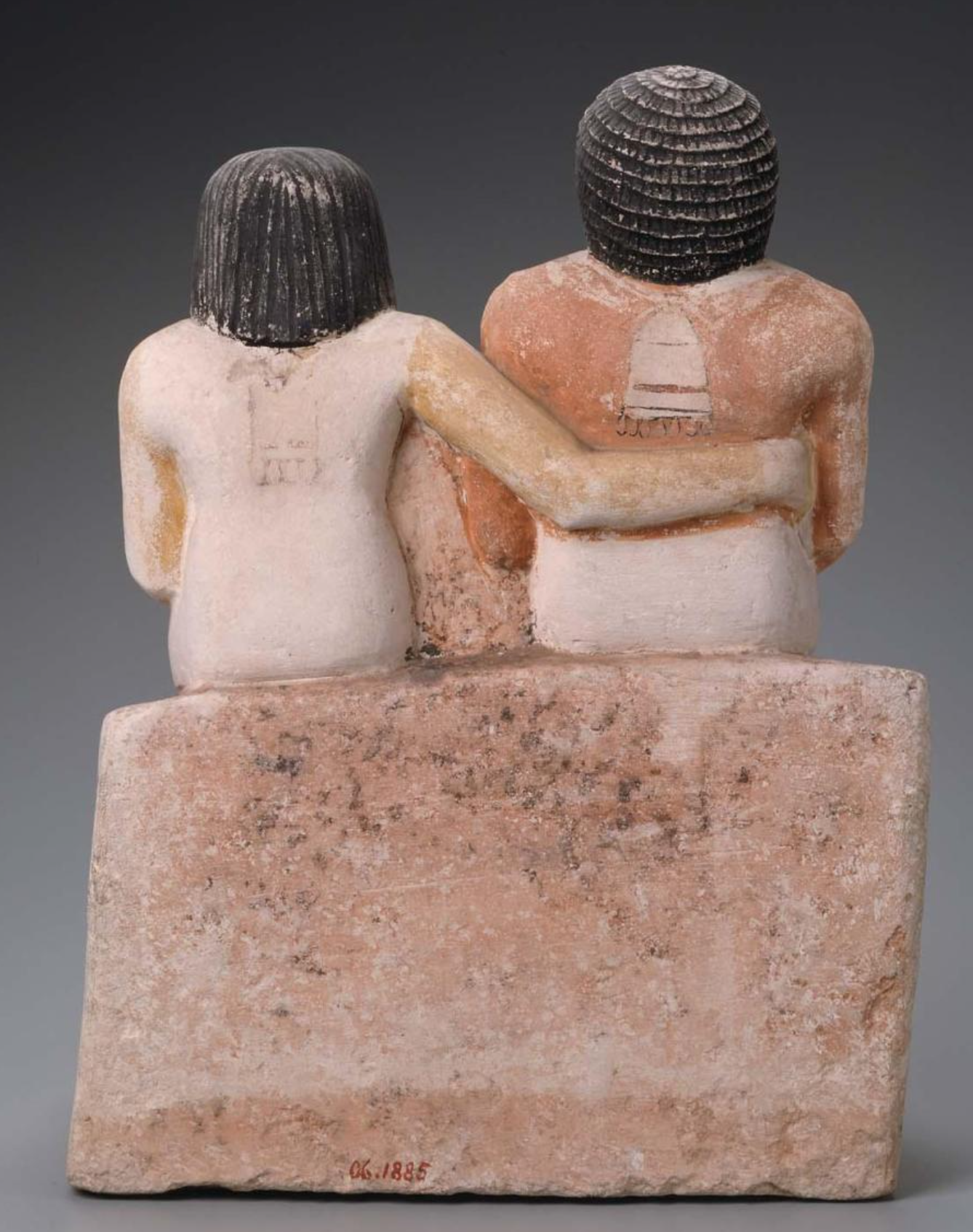
Dyad pair statues of the Old Kingdom
Pre-Class Exercise:
- Share an image of a dyad statue with your class – it can be one provided in this lesson or another from your selected textbook. Ask your students to observe the figures. How are they posed? Are there any clues about their relationship? What are the main keywords used to describe the statue? How might gender dynamics impact our assumptions and interpretations about these statues?
Explicitly intimate behavior was rarely represented in formal Egyptian art; however, depictions of couples in a mutual embrace were relatively common, especially in Egyptian dyad pair statues. These statues were typically placed in the tombs of the deceased to act as physical vessels for the deceased’ ka to inhabit, where they might receive offerings and observe the world of the living. Dyad statues sometimes depicted the deceased embracing a god or goddess, but they also often depicted married couples, whose names are identified through hieroglyphs carved on the back.
While some of these gestures show both man and woman engaged in a reciprocal embrace, most of them place the woman slightly behind the man, in a physically supportive or affectionately gesturing stance. Although men are typically centered as the larger more dominant figure in these pair statues, the woman’s presence and gesture indicate her significance as partner in the marriage. These statues were used in all periods of Egyptian history, but were most common during the Old Kingdom (2640-2134 BCE) in the 4th Dynasty. Below we will investigate two examples of 4th -5thDynasty dyad statues – the greywacke statue of Pharaoh Menkaure and his queen, and the non-royal limestone statue of Bau and Baru.
Discovered in the Valley Temple of Giza in 1910, the statue of Menkaure and his queen, likely Queen Khamerernebty II, is an extraordinary example of Old Kingdom royal statuary, perfectly exemplifying the dyad stylistic convention used in portraits of the royal family. The king is presented in a forward-striding pose, and wears the traditional royal kilt and nemes headdress. This posture and regalia were only worn by the pharaoh, representing his divine kingship and power. His queen stands directly at his side, though slightly behind him, while supportively embracing him around the waist and resting her arm on his. She too wears the form-fitted dress typical of women in ancient Egypt. Overall, this piece represents an ideological harmony between male rulership and female support, even legitimization, and reinforces the idea of ma’at through their partnership.
Dyad statues were also often included elite non-royal tombs, possibly to emulate some of the power and qualities found within royal statuary. The painted limestone statue of Bau and Baru is an example of an elite couple dyad, placed in the serdab to receive offerings from the deceased’ tomb owners’ family. The husband, Bau, wears a short kilt and a tight curly wig, while his wife, Baru, wears a long form-fitting dress, similar to the one worn by Queen Khamernebty II. Both wear detailed broad collars with realistic clasps in the back, typical garments worn by both men and women of the upper class. This dyad demonstrates the idealized social and familial roles that this couple fulfilled during their lifetime. Bau’s skin tone is noticeably darker than his wives,’ a convention used by artists to distinguish between man and woman. Both have idealized seated body forms – his athletic build suggests masculinity, while hers leans into feminine traits associated with beauty and fertility. The epithets carved into the statue provide more context to social status, it reads, “The Tenant Farmer, Bau” and hers states “The Priestess of Neith, Opener-of-the-Ways, and Tenant Farmer, Baru.”
Discussion Questions:
- To what extent can dyad pair statues be seen as expressions of individuality versus idealized social roles? Do these statues tell us more about the people they represent or about broader cultural ideals they were meant to embody
- How do gender dynamics of the time manifest in dyad statues? Using an example from class, describe the object using art historical terminology with a focus on the composition of the posture, positioning, and scale of the figures.
- Consider the purpose and final in-situ placement of dyad and triad statues. How might their materials and shape impact their longevity? Is there a physical advantage to having the couples connected (embracing) rather than standing separately?
- How are the dyad statues of Menkaure and Queen and Bau and Baru distinct from each other? How are they similar? Do their poses necessarily suggest one figure is supporting the other? Why or why not?
Daily Life and Fishing and Fowling Scenes
Egyptian tombs were filled to the brim with objects meant to be used again in the afterlife by the tomb owner. While some objects serve a practical purpose, like the inclusion of food offerings or models of granaries, others provide insight into the deceased’ personal preferences or desires for the next life. Eventually, Egyptian tomb walls began to include daily life scenes, depicting the deceased conducting business, managing their estates, or relaxing with their families. These scenes provide insight into life as an elite Egyptian living along the Nile River, with detailed images of people, clothing, property, agriculture, domestic crafts, and even species-specific representation of wildlife. They also communicate ideals of social order, representing not only snapshots of life in Egypt, but in the moments, and manner, of portrayal meant to manifest in the afterlife.
A recurring scene in elite non-royal tombs, especially prominent during the New Kingdom (1550-1077 BCE), was the “fishing and fowling” motif. These images were most common in the tomb chapels of higher-ranking officials and portray the tomb owner engaged in the leisurely activities of fishing or duck hunting along the Nile. The central figure is the tomb owner, usually shown standing on a reed boat, armed either with a spear for hunting fish, or a throw stick to take down flying ducks. His posture is active and commanding; sometimes an attendant or servants assist with the hunt. Often his wife and children are depicted in the background on the boat with him, smaller or seated, according to hierarchic scale.
The Tomb of Nebamun (TT 181) includes a scene of Nebamun hunting birds in the marshes, accompanied by his wife and his daughter seated in the boat, gripping his ankle. He stands proudly on his papyrus reed boat, with both arms raised – one threatens the birds with the throw stick, the other holds captured small white egrets by the legs. The family is surrounded by all the beauty and bounty the Nile River has to offer: tilapia representing fertility and rebirth, blooming papyrus and lotus flowers, and even butterflies. The imagery here emphasizes Nebamun’s dominant and idealized role as a master over the chaos of the Nile. His family supports him and observes his successes, immortalized and conforming to traditional canon in his tomb. Scenes like this also serve as a reminder of the Egyptians’ love for life’s pleasures, and a desire to continue family activities like this for eternity.
More nuanced examples of men and women at work in tomb scenes is visible in various agricultural images, possibly even personalized to match the property and garden layouts of their deceased tomb owners. The Tomb of Nakht (TT 52), “the astronomer of Amum,” includes many images of Nakht with his wife, Tawy, standing together to make offerings to Ra, banqueting scenes that include women asserting their own authority in unique roles as dancers or musicians, and harvesting scenes where women participate in the preparation of flax. These images represent an ordered world, and although gender roles may remain stratified, the presence and inclusion of family, even servants and farm laborers in these tomb chapel paintings, suggests that their place in society was valued as a critical component to continuity in the afterlife.
Discussion Questions
- How are distinctions in gender roles visually represented in “daily life” tomb scenes? What kinds of activities are men and women shown participating in? When does their work overlap and when does it differ?
- To what extent do you believe these depictions reflect the societal expectations of their time? Is characterization of the work idealized?
- Often the tomb owner is depicted as the central character in fishing or fowling scenes, accompanied by his wife and children. Considering their poses, which figures are active and which are passive? What might this composition tell us about ideals in family life and its significance in the afterlife? Does active vs. passive always determine if an action is important?
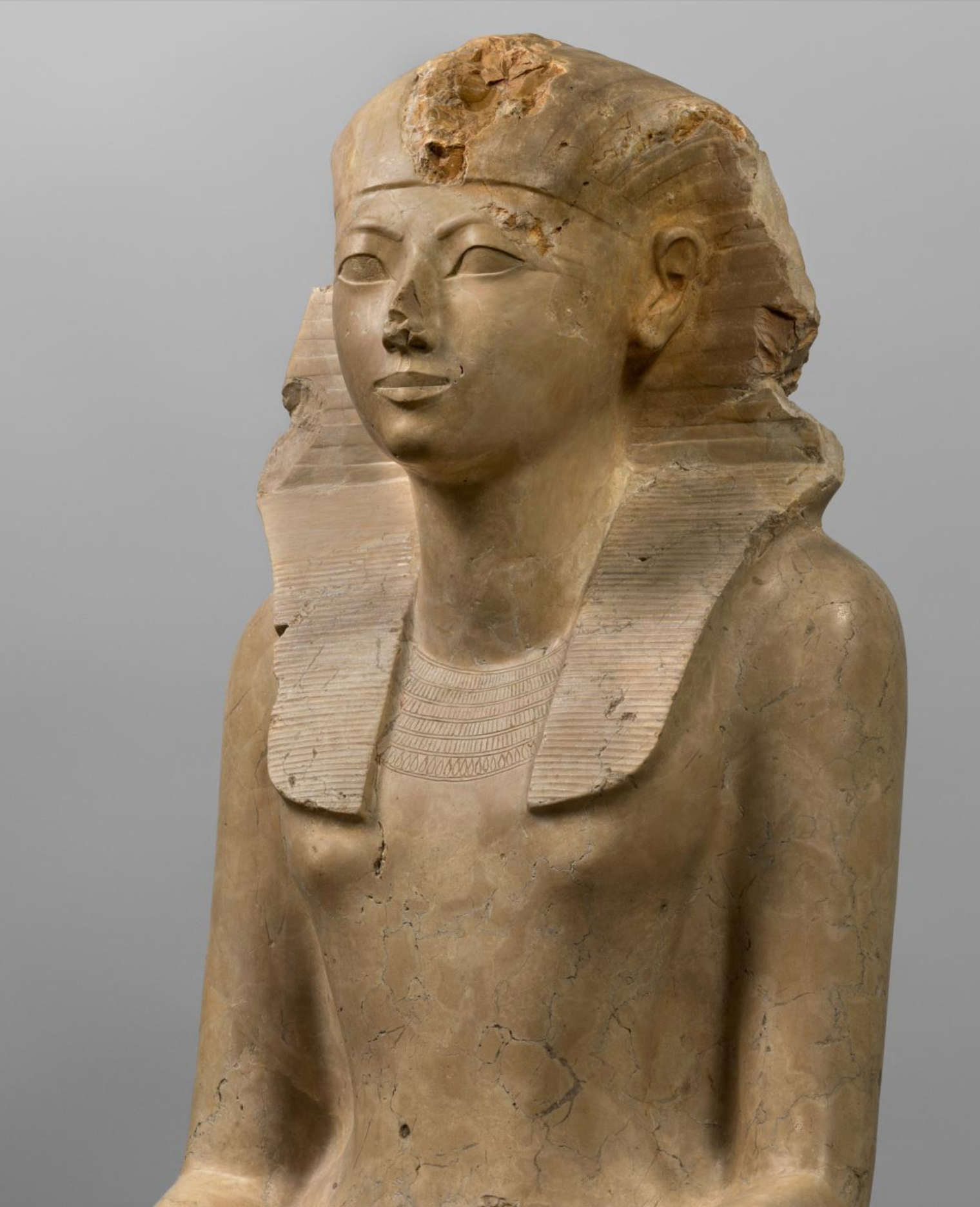
Hatshepsut’s Reign and Statuary
Egypt saw several female rulers rise to power and become powerful queens in their time, but the most well-known among them was the New Kingdom Queen, Hatshepsut, one of the most influential leaders of the 18th Dynasty (1479-1458 BCE). Her reign began when she served as regent for her stepson, Thutmose III, who was too young to ascend the throne as king on his own. In the earliest depictions of Hatshepsut, she is very clearly presented in her feminine form, conveying power, but only through her supportive role in queenly regalia. Statues and portraits at this time depict her with feminine curves, delicate facial features, and inscriptions refer to her with feminine titles.
As Egypt entered a period of new trade alliances and expanded building programs, Hatshepsut took the unprecedented step of proclaiming herself the pharaoh, usurping the throne from her stepson Thutmose III. In order to legitimize her authority in this role, Hatshepsut’s public royal statuary adopts the full royal titulary, and takes the throne name Maatkare. This titularly is used on her public statues, where both names are inscribed. At this point in her reign, her statuary begins to take on kingly regalia, although her own figure continues to conform to canon at this time. While she remains seated on the throne in poses typical of Egyptian queens, she wears the nemes headdress and masculine shendyt kilt. Seated statues such as this were likely used in private spaces to receive offerings, and would have had a smaller intended audience. At the same time, her public statuary took on an increasingly masculine style, eventually portraying her in the role of pharaoh as a man.
The latest periods of her reign portray her wearing all the regalia of a pharaoh, including the false beard and carrying a crook and flail. A life-size red granite statue at the Metropolitan Museum of Art depicts her as a broad shouldered and athletic build, in the kingly striding pose with the highly idealized masculine facial features. The inscriptions on the side, however, refer to Hatshepsut using both masculine and feminine forms. By embracing the recognizable visual tropes expected of the ruling pharaoh, Hatshepsut was able to position herself as the legitimate and divinely appointed king of Egypt. This approach also conforms to societal expectations of the time, keeping the visual language of kingship familiar, especially for the masses who may never see Hatshepsut in person but would be around her images.
After her death, however, these images were systematically destroyed. Her name and images of her in public temples were scraped away and defaced. It likely happened under the following rule of Thutmose III, but may have also been attributed to later rulers. Some of this destruction can be attributed to the expected attempt to restore the lineage of Thutmose III and an original line of succession. It is also possible, given the scale of destruction that there was a difficulty in accepting her memory as a pharaoh because of the non-traditional approach she adopted for her imagery. Later generations of royalty and elite officials may have been uncomfortable with the flexible adoption of a woman presented as the masculine pharaoh in title and image. Although many of her statues have been lost and broken, images of her in more private places like her chapel where she is presented in more feminine forms have survived.
Discussion Questions
- To what extent did Hatshepsut subvert or conform to gender norms to secure her position as pharaoh? Analyze her use of masculine titles, clothing, and iconography.
- Why was there an effort after Hatshepsut’s death to erase her from official records? Can you envision any nuance in how or why her images were destroyed?Is systematic erasure the same as modifying someone’s visual legacy? Reflect and discuss.
AT THE END OF CLASS
In this lesson, students explored how gender was codified in ancient Egyptian art, through conventions that adapted to reflect shifting social and political realities, as well as personal attributes of the individual. Beginning with Old Kingdom dyad statues, students discussed how posture and scale reflect ideas of both masculine authority and the corresponding, and necessary, feminine support. In New Kingdom tomb scenes family life and domestic roles were discussed, as well as the need to represent all elements of Egyptian society accurately so that they may be replicated in the next life. Lastly, Queen Hatshepsut’s reign and rise to power was analyzed through her statuary, as she was known for strategically adopting and adapting the masculine imagery needed to legitimize her rule.
Final Question:
- Using one of the images discussed in this lesson, have your students write a museum label for the general public that describes the works key points related to gender representation and why that matters for understanding Egyptian culture. This exercise asks students to reflect on what they’ve learned and condense it down into an easy-to-understand format.