The “Exceptional” Woman Artist in Early Modern Italy
Since Linda Nochlin first posed her famous question, “Why Have There Been No Great Women Artists?” in 1971, feminist scholars have leapt at the challenge of recovery, generating a number of monographs and exhibitions on women artists, working from the Renaissance to the present. In the course of this study, scholars have uncovered the pitfalls of writing about women: first, because there are few named women artists whose work survives, scholars have referred to the known and named women as “exceptional,” transforming these women into wondrous rarities; secondly, in privileging a small number of women creators, art forms like painting, as opposed to the decorative arts that are usually made by unnamed women, have come to define women’s art; and lastly, in trying to write about the art of women, a masculinist canon and its methodologies provides limited terminology and means of assessing their work, often leading to majorly biographical readings of these women and their art.
Centering our discussion on the early modern period—primarily during the Cinque- and Seicento in Italy—we will attempt to trace the idea of feminine exceptionalism through a historiographic overview, seeing how narratives of male genius borne in the Renaissance continue to corrupt the canon and the language we use around women. We will discuss the difficulties of writing about women, considering the writing formats we are limited to as well as the terminology. “Artist,” in and of itself is always presumed as male; when writing about women, one must preface the title of artist with gender, implicitly linking feminine characteristics with style, whether such a discussion holds true or not. The lesson aims to situate students within the historiography of the first named and known women artists.
Themes
- The Prodigious Youth turned Male Genius
- Female Exceptionalism
- Writing Women: The Monograph and its Discontents
- Changing the Narrative: The Unexceptional Woman Artist
Before beginning class, it would be helpful to assign students the excerpts from Vasari and Linda Nochlin’s essay, opening a discussion about some of the themes the students encountered. One can then begin a discussion by asking students to list all of the famous women artists, writers, philosophers, politicians, etc., that come to mind. Then, put up a list of names on the board of pre-modern women: ask the students why they may be less familiar with these names? Ask them to think critically about the way history has been written, who is included/ excluded.
Background Readings
The Prodigious Youth Turned Male Genius
- Giorgio Vasari, Lives of the Most Eminent Painters, Sculptors, and Architects, Gaston du C. De Vere. Sections on “Giotto” and “Michelangelo.” https://onlinebooks.library.upenn.edu/webbin/metabook?id=livespainters
Female Exceptionalism
- Giorgio Vasari, Lives, Gaston du C. De Vere. Sections on “Properzia de’ Rossi” and section devote to Sofonisba Anguissola in “Benventuo Garofalo and Girolamo da Carpi, and Other Lombards.” https://onlinebooks.library.upenn.edu/webbin/metabook?id=livespainters
- Sheila Barker, “The First Biography of Artemisia Gentileschi: Self-Fashioning and Proto-feminist Art History in Cristofano Bronzini’s Notes on Women Artists,” Mitteilungen des Kunsthistorischen Institutes 60, no. 3: 405-435.
- Mary Garrard, “Artemisia Gentileschi’s Self-Portrait as the Allegory of Painting.” The Art Bulletin 62, no. 1 (1980): 97-112.
Writing Women: The Monograph and Its Discontents
- Linda Nochlin. “Why Have There Been No Great Women Artists?” In Women, Art, and Power. Harper and Row, 1988.
- Kristen Frederickson and Sarah E. Webb, eds. “Introduction” to Singular Women: Writing the Artist. University of California Press, 2003.
Changing the Narrative: The Unexceptional Woman Artist
- Paris A. Spies-Gans. “Why Do We Think There Have Been No Great Women Artists? Revisiting Linda Nochlin and the Archive.” Art Bulletin 104, no. 4 (2022): 83-94.
- Andaleeb Badiee Banta. “Not Seen, Not Heard: In Search of the Unexceptional Woman Artist.” In Making Her Mark: A History of Women Artists in Europe 1400–1800, ed. Andaleeb Badiee Banta, Alexa Greist, and Theresa Jutasz Christensen (Toronto: Art Gallery of Ontario, 2023): 14–28.
Students should certainly be tasked with reading the excerpts from Vasari, listed above, as well as Linda Nochlin’s essay and Sheila Barker’s “The First Biography of Artemisia Gentileschi.” As this lesson is grounded in historiography, it is important that students are exposed to the primary sources about women artists.
Glossary
- Genius: the notion that an artist—usually male—was born with an inherent talent surpassing all others; this talent, or ingegno, is innate, unalterable, and unrivalled
- Monograph: a book dedicated to a single subject; in the case of the woman artist, the monograph is usually written as an in-depth biography with some reference to her art
- Attribution: the proposed (though not always certain) maker of a work of art
- History Painting: a multi-figure composition depicting a scene from classical mythology, the Bible, literature, or a historical event
CONTENT SUGGESTIONS
Key questions for the lecture:
How have women artists been written about in the past? How are they being talked about now? What are the limitations of some of our present methodologies? What constitutes “genius,” “exceptionality,” or “greatness”? In particular, what constitutes female exceptionality? How has the canon, as it relates
In one hour and fifteen-minute lecture you should be able to cover the following:
Gaetano Sabatelli, Cimabue and Giotto, 1846
Carlo Crivelli, Madonna and Child, ca. 1480
Daniele da Volterra, attr., Portrait of Michelangelo Buonarroti, c. 1545
Michelangelo, God Creating Adam from the Sistine Chapel ceiling, 1508-1512
Sofonisba Anguissola
Self-Portrait with Book, 1554
Self-Portrait with Cryptogram, 1556
Self-Portrait with Madonna and Child, 1556
Girl Laughing and Old Woman Studying the Alphabet, 1550s
Young Boy (Asdrubale?) Bitten by a Crayfish, 1554
The Chess Game, 1555
Self-Portrait with Spinet, 1555
Lavinia Fontana
Self-Portrait with Spinet, 1577
Self-Portrait in Studiolo, 1579
Minerva Dressing, 1613
Consecration of the Virgin, 1599
Artemisia Gentileschi
Susanna and the Elders, 1610
The Allegory of Inclination, 1615-1616
Self-Portrait as the Allegory of Painting, 1638-39
Judith Slaying Holofernes, 1620
Judith and Her Maidservant with Head of Holofernes, 1623-25
Isaac Claesz van Swanenburg, Spinning, Shearing the Warp, and Weaving, c. 1594-1596
Click for images: slide presentation

Introduction to the topic
Named women artists first appear in archival information in the Renaissance. Though we have the names of a few hundred women artists from the sixteenth through the eighteenth centuries, very few have oeuvres that survive into the present. As a result of this lack of visual evidence, the women whose art survives have often received the title of “exceptional,” being granted treatment in numerous monographs and individual exhibitions, with these texts lauding the women’s impressive biographies that allowed them to do what other members of their sex could not. However, by writing about these women in this fashion, art historians have re-appropriated the idea of male artistic genius onto these women: they continue to use methodologies that work within the existing canon, exalting a few women at the expense of many others. And, in the treatment of these few women, by calling them exceptions and fixating on their gender, art historians also often fail to discuss them within the context of their periods and within the same discourse as their male peers. In this lesson, the goal is to shed light on the myth of the male genius, how that myth came to be appropriated onto women artists through the use of the monograph, to highlight a few of these known women and the way they are discussed in the literature, and finally, to address the “unexceptional” woman artist.
Lesson
Beginning in the early modern period, when conceptions of selfhood were codified in writing, the first art critic, Giorgio Vasari, composed his Lives of the Most Eminent Painters, Sculptors, and Architects in 1550, to be revised and widely updated in 1568. Vasari structures his text as both teleological and circular: in essence, he proposes a series of declines and elevations in the history of art, with the classical period representing a high point, followed by an era of degradation in the Middle Ages, and then a moment of “rebirth,” or revitalization, in the so-called Renaissance. Vasari sees his own moment, the period of Raphael, Michelangelo, and Titian (to a lesser extent) as the highest point of art-making. Within the text, he includes a series of artist’s biographies, drawing a parallel between art-making and biological processes, and discussing their talents and most-famed works. This format of artistic biography ushered in an era of classifying male artists not as artisans or mechanical workers, but as creative geniuses with divine inspiration. The earliest example of this conceit emerges in Vasari’s section on Giotto, where he relates the tale of Giotto’s early proclivity toward art-making. According to the text, Giotto was always drawing “on stones, on the ground, or on sand” since he had a “natural inclination to the art of design.” One day, the artist Cimabue happened upon the boy, who he saw drawing a sheep on a flat slab of stone, and immediately asked the boy to join his workshop, an episode represented in Gaetano Sabatelli’s Cimabue and Giotto of 1864. Vasari then claims that Giotto alone “banished completely that rude Greek manner and revived the modern and good art of painting…which had not been used for more than two hundred years.” Vasari alleges that Giotto was a true “disciple of nature,” rather than any teacher, best recounted in his anecdote about a fly. Supposedly, Giotto’s teacher Cimabue was in the midst of painting a Virgin and Child, to which Giotto added a fly. Mistaking the insect as reality, Cimabue tried to brush it away to no avail, before realizing the illusion. While this painting by Cimabue no longer survives, Carlo Crivelli seems to hearken back to Giotto’s illusionism in his own Madonna and Child, where a fly can be seen buzzing about on the parapet wall, at the edge of the composition. This detail is striking, as it represents the way that the male artistic genius can fool even a practicing artist into believing in his fictive worlds: the male genius paints as though one were looking out a window, in Alberti’s famed comparison.
Though Giotto represents the earliest incarnation of Vasari’s topoi about the prodigious youth-turned genius, Michelangelo, or il divino, represents the highest point of artistic achievement. In the recounting of his birth, Vasari explains that Michelangelo was born under a divine star, “beyond…mortals,” and his zodiac foretold that “art of his brain and of his hand there would be seen to issue forth works marvellous and stupendous.” The connection between the hand and the mind is captured in Daniele da Volterra’sunfinished portrait of Michelangelo, where he decided to first place great emphasis on the face and hand of the master, leaving the torso in sketchy lines. This emphasis on Michelangelo’s genius even emerges in his youth, with Vasari noting that “since his genius drew him to delight in design, all the time that he could snatch he would spend in drawing in secret, being scolded for this by his father and his other elders, and at times beaten, they perchance considering that to give attention to that art, which was not known by them, was a mean thing and not worthy of their ancient house.” Unlike Giotto, Michelangelo came from semi-noble origins, and art-making was considered a profession below him, a notion that the young master would quickly correct. He began in the workshop of Domenico Ghirlandaio, who he quickly surpassed in skill and fame. His sculpture was considered to rival the ancients, as he famously fooled the well-known collector Isabella d’Este with a carved Cupid that she mistook for antique. But, in his Sistine Chapel frescoes, particularly in the scene of God Creating Adam, Michelangelo shows the full force of his art. At his core, Michelangelo was known for his disegno, his ability to draw anatomies, and he perfects the male form in this scene. While God is shown as the active agent, Adam extends his hand as the recipient force not just of God’s live-giving powers but also from Michelangelo’s brush, who can render flesh from both stone and paint. As Vasari later proclaimed, “This work, in truth, has been and still is the lamp of our art, and has bestowed such benefits and shed so much light on the art of painting, that it has served to illuminate a world that had lain in darkness for so many hundreds of years. And it is certain that no man who is a painter need think any more to see new inventions, attitudes, and draperies for the clothing of figures, novel manners of expression, and things painted with greater variety and force, because he gave to this work all the perfection that can be given to any work executed in such a field of art.” In essence, no painter could ever compete with the genius of Michelangelo.
These two selections from Vasari reveal how he rhetorically constructs the idea of artistic genius. Both of these artists always maintained an inclination to make art and showed their prodigiousness from a young age; they both quickly exceeded their masters; and their talent was innate and inherent. They learned to paint by studying nature (or the classical period). Have students engage in a close reading of these texts, and then have them compare Vasari’s language about these two men with his treatment of women artists. What similarities or differences do they notice?
In his text, Vasari mentions a few women artists: in the first edition, only Properzia de’ Rossi, a Bolognese sculptor, receives her own entry, with information about Florentine-nun Plautilla Nelli, Cremonese noblewoman Sofonisba Anguissola, and Countess Lucrezia Quistelli tacked onto her biography in the updated 1568 version. In this edition, he also modestly expands his discussion of women by including a secondary entry about Sofonisba among the other Lombard painters, though he still does not grant her a separate entry. In his language, Vasari refers to the “diligence” of female painters, and with Sofonisba, he even goes as far to remark that her figures are lacking “only in speech,” a device he even employs in Raphael’s entry. However, this praise is always qualified and conscripted by gender.
Art theoreticians of the sixteenth and seventeenth centuries do not mythologize women in the same way as they do male painters. Most texts, as noted by Fredrika Jacobs in Defining the Renaissance ‘Virtuosa’ and in Babette Bohn’s Women Artists, Their Patrons, and Their Publics in Early Modern Bologna, include one token woman as a rare wonder, a marvel. Only in Bologna, as argued by Bohn, are women treated on a more equal playing field in the rhetoric, a point to which one should return in a discussion of Lavinia Fontana. The point to emphasize with your students is that the mythologizing around the “exceptional” woman, while somewhat prevalent in the early modern idea of the meraviglia, is largely a postmodern and feminist intervention. You can continuously emphasize this point as you recount individual female biographies.
In order to counter Vasari’s narrative about the marvelous woman artist—a term with specific connotations relating to that which is foreign, strange, or unknown—early feminist scholar set out on a program of recovery, documenting the activity of the known women artists in individual studies and monographs. In this lecture, we will examine three specific case studies: that of Sofonisba Anguissola, Lavinia Fontana, and Artemisia Gentileschi.

To start, Sofonisba Anguissola was considered the first preeminent woman painter, even in her own time, with poets like Annibale Caro espousing her praises. She was born in the small town of Cremona, about 60 miles from Milan, between 1532-35 to a noble but impoverished family, as the eldest of seven children—six daughters and one son. Her father Amilcare, noticing his daughter’s talent for painting, sent her to train with a local painter, Bernardino Campi—an unprecedented move at the time, as girls were not supposed to leave the home. Sofonisba and her father then began a campaign of sending her self-portraits to local and foreign dignitaries, in hopes of securing a courtly position for her. In the mid-1550s, her production of self-portraits skyrocketed. The earliest image, Self-Portrait with Book features a very young, half-length Sofonisba peering at the viewer from against a green backdrop. She wears a black dress with maroon sleeves and lace trim around the color, an unusual fashion choice for a noble woman, as she is not wearing a sumptuous gown but a rather plain one. In her right hand, she holds a small book, containing the inscription “Sophonisba Anguisola virgo se ipsam fecit 1554,” indicating her literacy and familiarity with the Latin language. In this earliest mode of self-presentation, Sofonisba follows the prescriptions outlined by Baldassare Castiglione in his Il Cortegiano, or Book of the Courtier (1528), a behavior manual for court members. Sofonisba shows herself as a serious young woman, of good breeding, with an education, and with the ability to paint.
Sofonisba, with the help of her father, would continue this campaign in images like Self-Portrait with Cryptogram and Self-Portrait with Madonna and Child, demonstrating her cleverness and adaptive ability. In the former image, Sofonisba paints herself in miniature, holding a shield-like shape with a series of interlocking letters. Scholars have read this hidden message as spelling out ‘Amilcare,’ her father’s name. Around the border of the shield/ mirror-shape, Sofonisba including the inscription “Sophonisba Angussola Vir[go] Ipsum Manu Ex Speculo Depictam Cremonae,” translating to “The maiden Sofonisba Anguissola, depicted by her own hand, from a mirror, at Cremona.” The shape of the medallion itself recalls both that of a shield and also a mirror, alluding to her painting method, and, by showing her father’s interlocking initials, she may be staking a claim for herself as a reflection of her father’s talents, of the hope of her family. The use of the miniature also demonstrates her ability to paint at a number of different scales, showing an adaptability in form. But, in no other work is her adaptability so highlighted as in her Self-Portrait with Virgin and Child. In this composition, Sofonisba alternates between portraying herself in what had become her customary manner, while creating a devotional composition that clearly echoes Correggio and Parmigianino. Her teachers were followers of Correggio and the Corregesque manner, and she may well have been familiar with Parmigianino’s style from his prints. This composition-within-a-composition signals one of her earliest devotional works, and it also highlights her ability to easily navigate between styles, embodying a kind of sprezzatura, or the affected appearance of ease, touted in Castiglione’s text. Moreover, Sofonisba helps to create a precedent for showing women artists at work: in this painting, she proclaims herself loudly and directly as an artist, capable of both the manual labor and the idea of creation. While Catharina van Hemessen was the first woman painter to show herself in the act of painting, Sofonisba furthers this trope, staking a clear claim that women have the capacity to be artists. In her earliest self-portraits, Sofonisba represents herself as a lady fit for the court—a serious young painter, literate and clever, with a range of capabilities for stylistic adaptation, the perfect fit for a courtly setting.
In the literature on Sofonisba, the first sustained treatment was written by Ilya Sandra Perlingieri in 1992, entitled Sophonisba Anguissola: The First Great Woman Artist of the Renaissance. From the title alone, it becomes clear that early feminist scholars wanted to challenge the masculine notion of greatness that emerged in Vasari’s text. The monograph as a format—a book on a single subject—however, can quickly connotate problems. In Perlingieri’s treatment, and more recently in the monographs by Michael Cole and Cecilia Gamberini, Sofonisba’s biography tends to be the focus, relegating her art to a secondary tier of focus. In Perlingieri’s conception, Sofonisba is a great artist on the basis that she did what other women were not able to do: she actually worked as an artist. She was applauded by her courtly patrons; Michelangelo responded positively to her drawings [her Laughing Girl and Crying Boy Bit By a Crayfish]; and, at the end of her life, Anthony van Dyke even wrote a passage celebrating her abilities. However, while these accomplishments are vast and speak to her capacity as a painter, her treatment as “great” tends to be a reflection on her life story rather than her production. Moreover, Sofonisba’s biography itself—as a departure from many of the tenets that come to define the “woman artist”—helps to produce the myth of exceptionality. Because Sofonisba did not have an artist for a father, because she did not train at home, because she ventured outside of Italy to claim a career as a painter, she falls outside of the tropes established by modern scholars about a woman artist. Unlike in Vasari’s text, where male genius, though partially a rhetorical device, arises from his art-making, more often than not, the idea of female exceptionality derives from the life of a woman artist, with her art used only as an illustration.
While Sofonisba may have lived a life distinct from the experience of other female practitioners, her art itself embodies many conventions of a noble, sixteenth-century lady, and her training also shows how she fits within a tradition of Lombard naturalism. Lombardy, the region that produced artists like Leonardo da Vinci and Caravaggio, was much closer to the border between Italy and Northern Europe than other provinces. As a result, compositional styles or subjects from the North came onto the market in Lombardy. Lombard painters thus became famed for their use of naturalism—the idea of portraying something from nature, something from life—and for their genre scenes. In The Chess Game, Sofonisba portrays three of her sisters in the midst of a rousing chess match. The eldest looks out of the picture plane, presumably gazing toward Sofonisba as she paints, making her present in the composition, while the middle sister lifts up her right hand to try to gain the attention of the elder. The youngest seems amused by the antics of her two older sisters, and a nurse-maid enters the scene on the left to check on the girls. The painting is less about the actual match itself, as it is hard to reconstruct what is happening at this particular moment, and rather about showing the relationship between the girls, and the idea of restraint being acquired over time, as only the eldest sister fully couches her emotions. The painting also fits within the genre scene tradition of showing game play, as demonstrated in Giulio Campi’s Game of Chess (ca. 1530-34). While Sofonisba could be called “exceptional” as a woman artist, in many ways, her early style, of which we have the largest surviving corpus, shows her to be a painter very much attuned to the Lombard market and to conceptions of art-making within this geographic sphere.
While there are certain tropes associated with women artists—coming from an artistic family, specializing in portraiture or still life, for example—only one type of image remains consistent across a number of different women’s oeuvres: the musical self-portrait.Sofonisba created her own image of herself playing at a spinet in 1555. She dons her customary black gown, and she looks out at the viewer, while her hands gently rest against the keys. Another important facet of womanly accomplishment was the ability to play music. Following in the footsteps of her predecessor, a young Lavinia Fontana, also portrays herself at the spinet. Lavinia Fontana (1552-1614), unlike Sofonisba, came from an artistic family in Bologna. She made a career for herself as a painter of portraits, devotional images, altarpieces, and even mythological nude figures. Also, unlike Sofonisba or any of the other women artists who preceded her, Lavinia was the first woman artist to achieve professionalization. With the assistance of her husband—who acted as her broker—she was able to maintain a highly successful workshop in Bologna, before moving to Rome in the last decade of her life, where she received commissions from various popes, including Gregory XIII, Paul V, and Clement VIII, among the other Roman elite. Another way in which Lavinia differed from Sofonisba was in the fact that she was not noble, a fact made clear in her self-fashioning. While her Self-Portrait at the Spinet clearly borrows from Sofonisba iconographically, Lavinia clothes herself in a bright pink gown with large ruff, long necklaces made of coral, gold, and pearls, and golden hair accessories to match. She frames herself as a lady of noble origin, and she shows off her musical ability, while also including an easel in the background, highlighting a number of her vast talents. Her other Self-Portrait in a Studiolo offers an even more ornate depiction. This time, Lavinia dons a lavender gown with an even larger ruff, a giant golden cross, and a gleaming headdress. She presents herself in the act of writing while surrounded by classical statuary. Again, she promotes herself as learned, while simultaneously entering into a paragone—a debate about the relative merits of different art forms—between painting and sculpture. As she manages to create stone in a two-dimensional space, she signals her own talent and stakes a claim for the merits of painting.
Lavinia Fontana, like Sofonisba, was widely celebrated in her own lifetime. In his Felsina Pittrice, a compendium of the best artists from Bologna, Carlo Cesare Malvasia extolls Lavinia’s talent at equivalent to Van Dyck, noting how she painted for the pope. He also explains that all the ladies of Bologna vied to have a portrait produced by Lavinia, inviting her into their homes. He describes her works as so numerous as to be too many to recount, but her portraits are “gentle, diligent, tender, and people fall in love with them.” In the secondary literature, Lavinia has also been signaled out based on her professional career, as the first woman to paint altarpieces, and as the first woman to paint female nudes. While Lavinia was certainly a trailblazer, she also fit within the dictates of the Counter Reformation.
Lavinia was known to associate with Archbishop Gabriele Paleotti, the author of the Discourses on Sacred and Profane Images, a text outlining the dictates of ideal painting during the period of churchly reform. In her altarpiece, The Consecration of the Virgin, Lavinia represents the Virgin and Christ Child on high, with Saints Agnes and Elena kneeling at her feet, while pointing to Saint Donnino, who hands a key to two boys at the bottom of the work, the boys being members of the Gnetti family, for whom the work was made. Meanwhile, Saint Pier Crisogno pour oil into a bowl in order to anoint the heads of the two kneeling girls. This altarpiece is representative of the Bolognese tradition to represent children in altarpieces without their parents, emphasizing their prayerfulness, so the children could be seen as role models. The altarpiece also signals the hopes for the continuance of the Gnetti family.
While Lavinia’s mythological nudes may seem to contrast with this picture of a perfect Counter-Reformatory painter, Liana Cheney has argued that they really represent a Neoplatonic sentiment, showing how the contemplation of beauty from a terrestrial realm can lead to the contemplation of beauty in a higher realm. In Lavinia’s Minerva Dressing, a composition of original design, she displays the goddess with her defining features, including an olive branch/ tree, an owl, military attire, a gorget, a helmet, a shield, and a lance. Yet, as Cheney points out, the goddess has discarded these elements, choosing a narrative of peace over war, also consistent with a Neoplatonic reading. Still, other scholars have argued against ignoring the sensual or even erotic connotations of this painting. Lavinia’s late Roman oeuvre, particularly her mythological images, still warrants further consideration.

Following in the tradition established by Lavinia, Artemisia Gentileschi (1593-1653) also became known as a painter of nude female heroines. In her earliest dated history painting, Artemisia painted a Susanna and the Elders. As the story goes, the virtuous, young wife Susanna went out to her private bath one afternoon, when two lecherous old men came upon her. Seeing the beautiful woman, they were filled with lust, and they threatened her with a choice: either she would have sex with them, and they would remain silent about it, or, they would say that she lay with them, and she would be put to death. As a chaste woman, Susanna refused, and, ultimately, the Elder’s treachery was discovered, and they were put to death for their crimes. Artemisia has chosen to depict the moment of tension, when the Elders first approached Susanna. This composition shows a zoomed-in scene, with very little articulated background, as common in the school of Caravaggio at this time. The young Susanna is pressed against the wall of her bath, her hands up in a protective gesture, trying to shield her face and body from the gaze and touch of the libidinous old men. The one in brown grabs at her hair, while whispering conspiratorially in his friend’s ear, while the other makes a silencing gesture at Susanna. The painting assimilates the mode of Caravaggio, but in the psychological experience of Susanna, Artemisia portrays something totally new. While many Susannas painted by men show her as promiscuous or without clear psychological trauma, Artemisia’s version of the scene fully presents Susanna’s horror and the sinful behavior of the Elders.
Notably, in 2018, Sheila Barker re-discovered Cristofano Bronzini’s biography of Artemisia Gentileschi. The text proclaims that Artemisia first showed a proclivity for art-making at a young age, when she first added embroidery to a skirt. When “experts” saw this skirt, they were so convinced of Artemisia’s talent that they compelled her father, artist Orazio Gentileschi to teach her to paint. However, according to the text, Orazio refused and sent Artemisia to the convent of Sant’Apollonia in Trastevere, where an abbess exposed her to the work of Caravaggio, and she made copies after his paintings; the copies were so wonderful, that they stunned all the nuns in the convent, and when her father came to visit her, he too was floored by her work, which sold for 300, 500, or even 600 scudi. Interestingly, almost every point made about Artemisia in this text is patently false: based on archival data, she never lived in Sant’Apollonia, she did train with her father, and she probably did not fetch such high prices for her early compositions. As Barker has noted, Artemisia had only been in Florence for a short time when this biography was authored by Bronzini, and it is unlikely that he himself wrote these fabrications, as he would have no motive. In all likelihood, Artemisia created this biography about herself. Though she seems to have been limited in terms of literacy in her early life, this biography reflects the topoi used in Vasari: a prodigious youth capable of excellence, her ability to copy from a supreme master (potentially even surpassing him), and an oeuvre that was highly regarded and sought after. While the details of Artemisia’s life are not really reflected in this text, it is noteworthy that she followed Vasari’s pattern to stake a claim about herself as an artist. Her claims about her own excellence are represented in her Allegory of Inclination, a panel painted for the ceiling of the Casa Buonarotti, the home of Michelangelo the Younger. Michelangelo Buonarotti the Younger—a relation to the famed first Michelangelo—devised a series of subjects to decorate his home’s ceiling, and he requested the best artists in Florence to each paint a panel. He assigned the idea of “inclination” to Artemisia. Inclination stands for a natural proclivity toward art-making. In her stunning panel, she assimilates her own features with the allegorical woman, showing that she as an artist embodies the very principle of inclination.
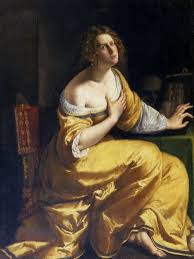
Similarly to the Allegory of Inclination, in her late oeuvre, Artemisia again adds her likeness to an image of the Allegory of Painting. Following the reference from Cesare Ripa’s Iconologia, Artemisia assumes the wild, dark black hair associated with the allegorical representation of painting. She shows herself holding a palette in her left hand, while her right sketches on a canvas already covered with dark ground. While this image is not a self-portrait in the strictest sense, just like the Allegory of Inclination, in assimilating some of her own features to the Allegory of Painting, Artemisia again points to her prowess as a creator. The only features from Ripa’s Iconologia that she fails to include is a tie around the mouth, as painting was considered a form of silent poetry. In this image, much like in her images of strong heroines, Artemisia refuses silencing. In her self-authored biography and in her paintings, Artemisia herself works to mark herself as exceptional as a woman artist, documenting the topoi of genius that she applies to herself. While the secondary literature has furthered this notion of Artemisia as surpassing all of her womanly peers (and some of the male ones too), Artemisia was a Caravaggista, who both had a clear vision of the kinds of works she wanted to produce and who was also influenced by market demands.
Despite the claims in her self-authored biography, Artemisia was taught to paint by her father, Orazio Gentileschi, a master of the Mannerist style who then became an ardent follower of Caravaggio. She traveled quite a bit throughout her lifetime, enjoying sojourns in Rome, Florence, Venice, Naples, and England. Artemisia quickly garnered a reputation for herself as a history painter in her youth, a genre then considered the highest form of painting. History painting refers to a multi-figure composition, replicating a scene from literature, mythology, the bible, or historical events. In particular, she was known for creating scenes showing women as heroes or unfortunate victims of the behavior of bad men. Her most famous paintings were made in Florence and Rome, and they depict the biblical heroine Judith. As the story goes, Judith was a Jewish noble in the town of Bethulia, which was attacked by the Assyrian general Holofernes. In order to save her home, Judith dressed in her finery and ventured to the commander’s tent, where she proceeded to offer him wine until he succumbed to the alcohol and fell asleep. Once he was in his drunken stupor, Judith and her maidservant took action: they beheaded the general to save their home. In the first scene, Judith Slaying Holofernes, Artemisia presents the moment of the killing, showing Judith with sharp precision wielding her sword; her companion helps to hold the general down. The blood from Holofernes’ neck spurts onto the white linens as he tries to claw the women away to no avail. The scene is terrible and gruesome, horrid and gory. While Caravaggio’s depiction of Judith shows a young woman attempting to slay the general, there is no force in her motion, unlike in Artemisia’s composition. These two women mean business. In a secondary scene painted after Artemisia had returned to Rome, Judith and her maidservant are shown within Holofernes’ tent, gathering the head into a sack. Judith still holds her sword, and raises her hand in a gesture of hesitancy, perhaps hearing something in the enemy camp. She stands behind a table with a lit candle, creating stark shadows that dance across her face. Artemisia creates an ideal sense of Baroque theatricality in her early work.
Artemisia was one of the first women artists to create history paintings, and she was one of the first to unabashedly claim a reputation for herself as a great artist. Writing to one particular patron, she declared that “you will find the spirit of Caesar in the soul of a woman,” daring to compare herself to one of the most eminent Roman statesmen ever to live. Artemisia’s art is deserving of scholarly analysis on its own merits, but, unfortunately, much like Sofonisba, Artemisia’s life story tends to be the driving force in any analysis of her work. One even in particular—the sexual assault perpetrated by her father’s artistic collaborator, Agostino Tassi—drives the narrative behind Artemisia’s painting. In every Susanna and Judith, scholars have tried to argue that these images are reflections of Artemisia’s own terror or revenge-seeking catharsis. While the narratives of the male artists around her, namely Caravaggio who was known to have lived a violent life, never have their art boiled down to a mere biographical reading, the narrative of Artemisia’s greatness tends to be tied to the horror of her life story and the sensationalism of the trial that followed. But a biography of Artemisia cannot encapsulate her innovative capabilities nor fully describe the period in which she worked, her influences and patrons. To fully analyze and appreciate Artemisia’s work, we need to think critically about how we define “greatness” and the methods we use to read her paintings.
The myth of female exceptionality is always linked to the myth of male genius, in that it relies on the same formats—the biographical monograph and the construction of the canon—to tell a similar story. While named and known women artists deserve recognition for their accomplishments, to boil them down to their biographies risks total alienation. These women are often not considered within the broader contexts of their eras, and their production becomes secondary to their lives. Moreover, in only prioritizing narratives about named and known women, we neglect to recognize the achievements of those women producers who were never written about, whose productions no longer exist, or who never signed a work or a contract to indicate authorship. In Isacc Claesz van Swanenburg’s Spinning, Shearing the Warp, and Weaving, he represents three women all engaged in textile production. Textiles, as decorative arts, tend not to receive the same treatment as paintings, but they tell a different story about female productivity: they show the way that the everyday, “unexceptional” woman artist went about her craft. The production of women outside of the small group of named producers is frequently neglected in scholarship. By focusing on the “unexceptional” woman artist—both unnamed women who produced decorative arts and the known women who we must read within the contexts of their period rather than through their biographies—can we write an accurate narrative about women makers.
DELIVERY SUGGESTIONS
This section could address several of the following issues:
- How do you communicate to students that this material is important?
- In order to understand the way women artists are written about in art history today, it is important to understand their treatment in past scholarship. If students are interested in writing about or studying women artists, they need to understand the state of the field in order to address the methodological problems. Even if they are only interested in passing, this material matters because it shows students the way women have been tokenized both in the primary sources and in scholastic research. If you engage students in the activity where they must list the women artists, writers, creative producers they are familiar with, most of their lists will likely not include any female figures predating the nineteenth or twentieth centuries: this gap signals a major problem in the way historical women are written about.
- What challenges have you encountered with teaching this material? How have you handled those challenges?
- It may be difficult to teach this material if students do not have a background in pre- or early modern art history. It may be necessary to incorporate a basic timeline—in line with Vasari’s text—to briefly show students the art of the High or late Renaissance that Vasari favored in order to impress upon them how women’s work differed/ overlapped.
- How, historically, has teaching this topic changed? (Is there a lesson in historiography here?) What has changed in how this topic is approached in the classroom?
- Historically, women artists have been discussed only or predominantly in terms of their biographies. If the students have no or little background with early modern women artists, it can be difficult to circumvent the need for biography, though a lesson in background should not dominate the whole class discourse. Only recently have scholars begun to think about women in terms of Marxist, globalist, ecocritical, and socio-historical frameworks, so the material in this lesson should reflect some of the varied paths students can engage with.
- What are some ideas on how to engage students, whether in online activities, in-class activities, group activities, pre-class activities or preparation, active learning ideas, discussion questions, etc.?
- Have your students read the primary sources before class. Take as much time as you are able to fully parse the language, to understand the tropes that still inflect art history today. If you wanted to implement a longer-term assignment, ask students to create an exhibition proposal. What has already been written about their subject(s) of choice? Can they have a monographic exhibition without employing the ideas of exceptionality or genius? How has the institution helped to promote the ideas of canonicity? How has the museum as an institution pushed back against the idea of canonicity?
- What are some variations or modifications in the above depending upon the level of difficulty of the course?
- The number of women practitioners can be pared down to focus just on Artemisia Gentileschi, in particular, as her self-conscious writings about her place within the history of art exemplify many of the themes discussed. The excerpts from Vasari could also be shrunken to focus just on his anecdotes about Giotto and his writings about women.
AT THE END OF CLASS…
Summarize the take-aways from the lesson. Include points of further discussion.
- The ideas of male genius and female exceptionality are really one and the same, and they are grounded in the same topoi; they also depend heavily on biography, which tends to be the only lens in which women’s art is read
- By prioritizing writing formats like the monograph, we continue to perpetuate the importance of biography about all other aspects of women’s work. We also alienate the named and known women, turning them into “exceptions” wholly distinct from artistic trends, practices, and patrons in their period
- Only by analyzing women’s work through other methodologies, such as globalism or Marxism, and by examining the “unexceptional” woman artist, an unnamed, unknown producer, can we more accurately write a narrative about women artists
- Points of further discussion: what are some other methodologies we can use to discuss these women? How can a public-facing exhibition be used as a tool to remedy this problem? If you were to teach a class on women artists or women in art, how could you structure the course to avoid some of the problems listed above?