Feminist Video Art
First Things First…
This lesson plan introduces students to the histories of video art, with a specific focus on feminist video in the US between the early 1970s and mid 1980s. Second-wave feminist liberation politics and portable video emerge into public consciousness concurrently in the United States. And yet, there has been little attention to the ways in which feminist politics shape and influence the subjects and forms of women’s video art histories.
This lesson begins with a brief overview of the unique technological qualities of video as a medium as well as its most significant theoretical and curatorial frameworks in art-world discourses. The lesson plan also briefly addresses the question of screening infrastructures – where were these videos shown and viewed by audiences – highlighting alternative spaces like the New York Women’s Video Festivals. The remainder of the lesson focuses on a discussion of individual video art projects by women artists. The plan includes prominent works like Joan Jonas’s Vertical Roll (1972), Martha Rosler’s Semiotics of a Kitchen (1975), and Dara Birnbaum’s Technology / Transformation: Wonder Woman (1978 – 79) alongside less well-known, yet conceptually and formally innovative works such as Susan Mogul’s Dressing Up (1973) and Shigeko Kubota’s Video Girls and Video Songs for Navajo Sky (1973), a personal favorite. These works are then discussed in the lesson plan both by the type of category of video art which they exemplify – performance for camera or video sculpture, for instance – as well as the feminist themes they address – performing gender or critiquing the domestic, for instance.
Themes
While the terms “video” and “film” are often utilized synonymously today (following the advent of digital video), analog video is very different from film. Analog video refers more specifically to the technology which was first made widely available to the consumer market in the United States in the late 1960s. Unlike film, which is a light-sensitive medium like photography, analog video is an electronic medium. It is therefore technologically related to mass-media like radio and television, and not film.
Video has several unique properties which are central to understanding many of the earliest works of video art:
- First, as an electronic medium, the image we see on screen is in many ways an illusion. While anyone looking at a televisual monitor during the 1970s sees a discernible object, what they are actually seeing are thousands of moving electronic signals being scanned so fast that our eye is only able to discern the resolved image. I typically explain this concept to students by comparing early video to the difference between seeing Seurat’s La Grande Jatte close-up versus far away. While not a perfect analogy (video signals are continuously being scanned, for one thing), I have found that it makes the basic premise of analog video more digestible for students.
- Second, one of video’s most important unique characteristics is that it allows for live-feedback. An artist could see themselves perform in real-time on the video’s playback monitor. For this reason, one of the central discourses which emerged in relation to early video art focused on its instantaneity and immediacy. As we’ll see, women artists were frequently critical of this concept, especially the ways in which it was often linked to a sense of intimacy with the subject of a video.
- Third, video could be made and screened in two different ways: as a closed-circuit, between the artist, the camera, and the monitor, and open-circuit, as a broadcast. While some artists worked primarily with just one of these strategies, many artists at the time worked in and across these categories.
- Finally, video was intimately linked to television. This was on the one hand, a source of immense anxiety for artists, who sought to distinguish video as a high-art from the mass-media form of television. For others, videos’ televisual form was a site of utopian experimentation. This dual relation between video and television – anxious versus radically utopian – would frame much of the early histories of experimental video art.
The historic narratives of video art frequently separate early video into two distinct groups: a more technologically experimental form of video as art versus the more documentary form of video as activism, or what is often referred to as guerilla TV practices. One of the fundamental goals of this lesson plan is to show how arbitrary and artificial these distinctions are, especially in relation to women’s video.
Background Readings organized by themes
Early foundational texts on video art:
Buchloh, Benjamin. “Allegorical Procedures: Appropriation and Montage in Contemporary Art,” Artforum, September 1982.
Krauss, Rosalind. “Video: The Aesthetics of Narcissism,” October 1 (Spring, 1976): 50-64.
Leeson, Lynn Hershman. “Reflections on the Electric Mirror,” in New Artists Video: A Critical Anthology ed. Gregory Battcock (New York: Dutton, 1978): 36-39.
Rosler, Martha. “Video: Shedding the Utopian Moment,” in Decoys and Disruptions: Selected Writings, 1975-2001 (Cambridge: MIT Press, 2004).
Sturken, Marita. “TV as a Creative Medium: Howard Wise and Video Art,” AfterImage, May,1984.
More recent general historic and philosophical trajectories of video art:
Boyle, Deirdre. Subject to Change: Guerilla Television Revisited (New York, NY: Oxford University Press, 1997).
Churner, Rachel, Rebecca Cleman, and Tyler Maxin, eds. The New Television: Video After Television (Cambrdige, MA: MIT Press, 2024).
Doug Hall and Sally Jo Fifer, eds. Illuminating Video: An Essential Guide to Video Art, (Aperture / Bay Area Video Coalition, 1990).
Kaizen, William. Against Immediacy: Video Art and Media Populism (Hanover, NH: Dartmouth College Press, 2016).
Mehring, Christine. “Television Art’s Abstract Starts: Europe circa 1944-1969” October 125 (Summer, 2008) 29-64.
Spielmann, Yvonne. “Video: From Technology to Medium,” Art Journal, 65, no. 3 (Fall, 2006).
Wagner, Anne M. “Performance, Video, and the Rhetoric of Presence,” October 91 (Winter 2000): 59-80.
Background Readings on Feminist Video & Specific Artists:
Barlow, Melinda. “Feminism 101: The New York Women’s Video Festival, 1972-1980” Camera Obscura 18, no. 54 (Dec 1, 2003).
Birnbaum, Dara. “The Individual Voice as a Political Voice: Critiquing and Challenging the Authority of Media,” in Women, Art, and Technology eds. Sean Cubitt and Roger F. Malina (Cambridge, MA: MIT Press, 2003).
Bowles, John P. “‘Acting Like a Man’: Adrian Piper’s Mythic Being and Black Feminism in the 1970s,” Signs 32, no. 3 (Spring 2007).
Bradnock, Lucy. “Lousy Revolutionaries: Fiction, Feminism, and Failure in Ilene Segalove’s The Riot Tapes (1984),” Oxford Art Journal 42, no. 1 (March, 2019): 69-89.
Cranston, Meg. “Everything’s Important: A Consideration of Feminist Video in the Woman’s Building Collection,” in California Video: Artists and Histories, ed. Glenn Phillips (Los Angeles, CA: Getty Publications, 2008), 269-73.
Demos, T.J. Dara Birnbaum: Technology/Transformation: Wonder Woman (London, Afterall Books, 2010).
EAI Oral History with Susan Milano: https://features.eai.org/oral-histories/susanmilano
Fateman, Johanna. “Notes on Vamp: Joan Jonas’s Organic Honey’s Visual Telepathy,” Artforum, 53, no. 10 (Summer, 2015).
Juhasz, Alex.“A Process Archive: The Grand Circularity of Woman’s Building Video,” in Doin’ It in Public: Feminism and Art at the Woman’s Building, eds. Meg Linton, Sue Maberry, and Elizabeth Pulsinelli (Los Angeles, CA: Otis College of Art and Design, 2011), 96 -125.
Richmond, Susan. Lynda Benglis: Beyond Process (New York: I.B. Tauris & Co. Ltd., 2013).
________. “The Ins and Outs of Female Sensibility: A 1973 Video by Lynda Benglis.” Camera Obscura 23, (3(69)) 2008, 81-109.
Shaskevich, Helena. “We Were There All Along: A Reckoning Between Open Circuits and the Women’s Video Festivals.” In The New Television: Video After Television, edited by Rachel Churner, Rebecca Cleman, and Tyler Maxin. MIT Press, 2024.
Shaskevich, Helena.“‘with a portapak on my back’”: Identity and Belonging in Shigeko Kubota’s Broken Diary” in Transnational Belonging and Female Agency in the Arts. Bloomsbury Press, 2022.
Shaskevich, Helena. “Joan Logue’s Newly Rediscovered & Digitized Words, 1-5.” Art Journal 81, no.3, 2022: 88-97.
Wilson, Siona. “Abstract Transmissions: Other Trajectories for Feminist Video,” in Abstract Video: The Moving Image in Contemporary Art, eds. Gabrielle Jennings and Kate Mondloch (Oakland, CA: University of California Press, 2015): 50-66.
Suggestions for videos:
Martha Rosler’s Semiotics of the Kitchen: https://smarthistory.org/martha-rosler-semiotics-kitchen/
Joan Jonas Early Performances: https://art21.org/watch/extended-play/joan-jonas-new-york-performances-short/
Susan Milano | Women’s Video Festival Collections: https://mediaburn.org/digital-exhibitions/susan-milano/
Notes on Accessing these Video Works:
Video art can be maddeningly difficult to access at times. Unlike more “traditional” mediums like painting, sculpture, works on paper, etc, video (as well as film & most moving image works) are rarely fully accessible through museum “collection” portals. Electronic Arts Intermix (EAI) and Video Data Bank (VDB) are the main distributors of video art in the US and where one can find the bulk of the videos included in this lesson plan. Both distributors offer educational streaming services and are very generous in making work available for pedagogical purposes. Additional useful resources for early feminist video include Media Burn and the Visual Studies Workshop (VSW), both of whose archival collections are mostly publicly accessible.
Suggestions for student readings:
- Discuss Lynn Hershmann Leeson’s “Reflections on the Electric Mirror” in relation to the first set of slides from the lecture, highlight how women used video’s live-feedback to see and explore their own images in real-time, but also how they used live-feedback to critique the idea of video’s immediacy and intimacy with the subject.
Leeson, Lynn Hershman. “Reflections on the Electric Mirror,” in New Artists Video: A Critical Anthology ed. Gregory Battcock (New York: Dutton, 1978): 36-39.
- Discuss Helena Shaskevich’s “We Were There All Along” in relation to the infrastructures section of the slide lecture. This essay provides a brief overview of one of the few screening venues for early women’s video art, the New York Women’s Video Festivals organized by Susan Milano and discusses the lack of representation of the artists from the festivals at MoMA’s Open Circuits conference.
Shaskevich, Helena. “We Were There All Along: A Reckoning Between Open Circuits and the Women’s Video Festivals.” In The New Television: Video After Television, edited by Rachel Churner, Rebecca Cleman, and Tyler Maxin. MIT Press, 2024.
Glossary
Analog Video: refers to video which utilizes a continuous electronic signal that captures and transmits moving images using varying voltage levels, commonly used in formats like VHS, Betacam, or early broadcast TV. Portable video, when it first became commercially available in teh United States, was a form of analog video. The signals were recorded onto magnetic tape (reel-to-reel or later U-matic cassettes). These signals were analog, meaning they represented visual and audio information through continuous electrical waveforms, not digital data.
Electronic Signal: In analog video, an electronic signal carries information about an image as a voltage waveform that varies continuously over time. Unlike digital signals (which use binary 0s and 1s), analog signals are smooth and uninterrupted, capable of representing subtle variations in light and color. A camera converts incoming light into electrical signals via its image sensor (e.g., a tube or CCD sensor). Brightness (luminance) and color (chrominance) are translated into varying voltages. These voltages are sent over cables (coaxial, RCA, etc.) as a composite video signal or separated into component signals. The signal carries timing data (sync pulses) so that a display device can reconstruct the image frame-by-frame. A monitor or TV interprets the analog signal in real time, converting voltage back into visible light via a cathode ray tube (CRT) or other analog display method. [See slide #3]
Portapak: a portable video recording system introduced by Sony in 1967, allowing artists and activists to capture and playback video outside of studio settings, revolutionizing independent media production. Although a “portapak” is a specific device manufactured by Sony, the term quickly became eponymous with “portable video”.
Second-wave feminism: (1960s–1980s) was a social and political movement focused on issues such as reproductive rights, workplace equality, sexual liberation, and the critique of gender roles.
Instantaneity:
Live-feedback: in video refers to the immediate display of a video signal from a camera or source device, allowing performers or viewers to see themselves in real time.
Open-circuit vs. closed-circuit: An open-circuit video system broadcasts signals publicly (e.g., TV), while a closed-circuit system (CCTV) transmits video to a limited, private network, often used for surveillance or feedback loops.
Guerilla TV: refers to a 1970s countercultural video movement that used low-cost video equipment like the Portapak to challenge mainstream media narratives and democratize media production.
Single-channel video: refers to a work displayed on one screen or monitor, presenting a linear, unified stream of audiovisual content.
Multi-channel video: involves multiple screens or projections playing simultaneously, often in an installation format, creating layered or spatially immersive experiences.
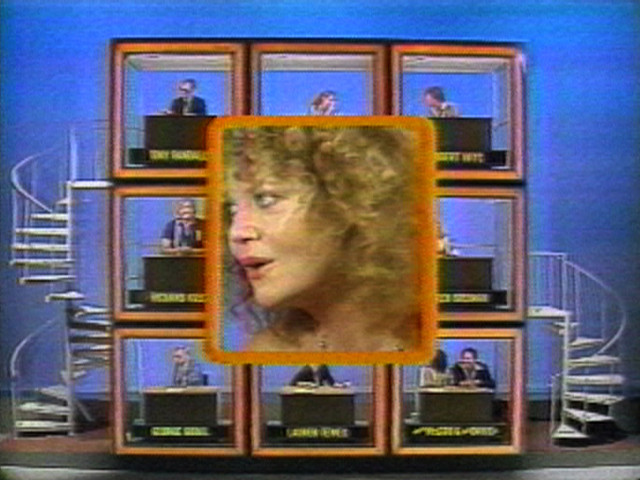
Dara Birnbaum, Kiss the Girls: Make Them Cry, 1979 (at MoMA)
CONTENT SUGGESTIONS
Key questions for the lecture:
How do artists engage with mass-media? And representations of women in mass media?
How do artists critique video’s immediacy?
How do women create alternative screening venues for their videos?
Timeline: This lecture discusses women’s video art in the United States beginning in the late 1960s. Single-channel, closed-circuit video dominates this period. It traces histories of feminist video through the 1970s as video expands into mass-media and video sculpture practices. It ends with the expansion of video in the 1980s into computer graphics on one hand and multi-channel video installations on the other.
In one hour and fifteen-minute lecture you should be able to cover the following: List of works from slideshow
Hermine Freed, Two Faces, 1972
Joan Jonas, Left Side, Right Side, 1972
Lynda Benglis, Now, 1973
Joan Jonas, Organic Honey’s Visual Telepathy, 1972
Joan Jonas, Vertical Roll, 1972
Susan Mogul, Dressing Up, 1973
Shigeko Kubota, Video Girls & Video Songs for Navajo Sky, 1973
Hannah Wilke, Gestures, 1974
Theresa Hak Kyung Cha, Mouth to Mouth, 1975
Howardena Pindell, Free, White, & 21, 1980
Nina Sobell, Chicken on Foot, 1974
Martha Rosler, Semiotics of the Kitchen, 1975
Suzanne Lacy, Learn Where the Meat Comes From, 1976
Dara Birnbaum, Technology / Transformation: Wonder Woman, 1978-79
Dara Birnbaum, Kiss the Girls: Make Them Cry, 1979
Shigeko Kubota, Duchampiana: Nude Descending a Staircase, 1976
Shigeko Kubota, River, 1979
Click for images: Slide Presentation

Introduction
Second-wave feminist liberation politics and portable video emerge into public consciousness concurrently in the United States. For many women, video was a medium closely allied with the notion of freedom. Video was not only portable and accessible, but also unburdened by the historic weight of male mastery associated with more traditional mediums on the one hand, and the infrastructural inequalities of established television networks on the other. Its democratizing possibilities made it an ideal medium for women. Realizing that self-representation was a political act with liberatory potential, women took up the camera enthusiastically and frequently, recording their daily lives with a sense of profound urgency.
Dominant video art discourses have historically over-emphasized a split between art and activism. Early women’s video art highlights the artificiality of this distinction. For women, video manifested the feminist adage, “the personal is political ”; it was both a medium of interiority, a closed-circuit between the artist, her camera, and the image on the monitor, as well as a social medium, recording political issues and broadcasting them to a wider community. These categories often overlapped, as women were empowered to experiment with videos’s signaletic properties while documenting intimate moments in their own lives, and to then share those recordings with viewers.
Lesson
This lesson introduces students to the first decade of women’s video art in the United States following the introduction of the portable video camera, or what was commonly referred to as the portapak. The lesson begins by explaining some of the distinct technological features of portable video, many of which women artists not only experimented with, but were also frequently critical of in their work. The discussion in this section should begin with the fact that early video is an electronic moving-image medium. This is an important quality which distinguishes it from other moving-image mediums such as film. The image which appears on the monitor, or what would typically have been a cathode-ray tube (CRT) monitor at this time, consists of continually scanned electronic signals. It is therefore important that students know that the video image which we see on the monitor is 1) unstable, only appearing stable to our eyes because of how quickly the electronic signals are scanned in real-time and 2) can be manipulated by manipulating the electronic signals. The other unique technological quality which pertains to video and is important to explain to students at the beginning of the lesson pertains to video’s capacity for live-feedback. This means that artists could watch their recorded image on a monitor as they performed in front of a camera in real-time. This was a transformative element for many artists at the time and was frequently incorporated in performance and media art alike. It was likewise one of the central reasons video was so frequently referred to during its early years as an “instantaneous” medium. As the lesson plan will show, the “stability” and “instantaneity” of the video image will emerge as some of the biggest points of critique for feminist video.
The next set of slides introduces one of the central theoretical frameworks of early video art: its relationship to television. In these slides, it’s important to discuss television as a source of both inspiration and anxiety for video art. While the portapak made televisual content more accessible, this accessibility and reproducibility spurred artists’ anxieties about video’s ties to the populist form of mass-media. This section includes a discussion of some of the central exhibition moments in the histories of this relationship including the seminal 1969 exhibition, “TV as a Creative Medium” at the Howard Wise Gallery, John Margolies’s essay in Art in America, “TV – the Next Medium,” and the Open Circuits conference at MoMA.
The final set of introductory slides focuses on screening infrastructures, pointing students towards the type of spaces where experimental video might be seen during this time period. While there are a number of possible case studies available for this section – video was frequently screened not only at experimental artist-run spaces like The Kitchen, but also museums like The Everson or the Long Beach Museum of Art – the section focuses specifically on The New York Women’s Video Festivals. This is a deliberate choice, made to call attention to a significant, yet underrepresented alternative screening space focused specifically on showcasing women’s work.
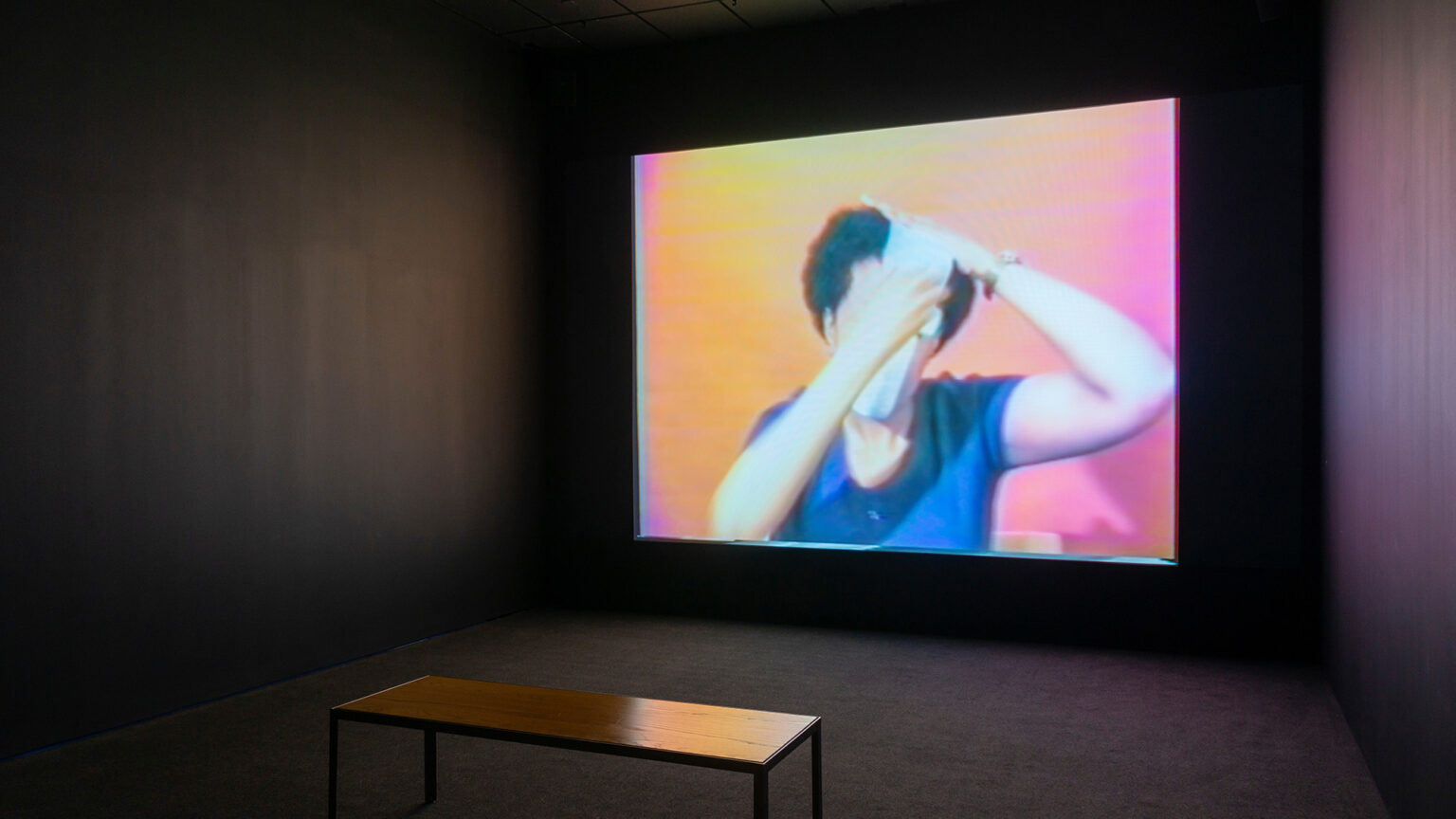
Howardena Pindell, Free, White, & 21, 1980 (at the Baltimore Museum of Art)
Feminist video slides:
Finally, the remainder of the lesson focuses on a discussion of individual video art projects by women artists. The plan includes prominent works like Joan Jonas’s Vertical Roll (1972), Martha Rosler’s Semiotics of a Kitchen (1975), and Dara Birnbaum’s Technology / Transformation: Wonder Woman (1978 – 79) alongside less well-known, yet conceptually and formally innovative works such as Susan Mogul’s Dressing Up (1973) and Shigeko Kubota’s Video Girls and Video Songs for Navajo Sky (1973), a personal favorite. These works are then discussed in the lesson plan both by the type of category of video art to which they belong – performance for camera or video sculpture, for instance – as well as the feminist themes they address – performing gender or critiquing the domestic, for instance.
The first section focuses on the concept of the “electric mirror”, a term borrowed from Lynn Hershmann Leeson’s 1978 essay. This section features Hermine Freed’s Two Faces (1972), Joan Jonas’s Left Side, Right Side (1972) and Lynda Benglis’s Now (1973). These works highlight women artists’ early use of video’s live-feedback to experiment with their own recorded images. Equal parts playful and sensual, these works call attention to the ways in which women artists use touch to disrupt the notion of an instantaneous, reflexive image.
The following section brings together several key works which focus on performing identity. This section is one of the longest and spans across the decade, highlighting the sustained interest in performing identity in feminist video art. The section begins with Joan Jonas’s Organic Honey’s Visual Telepathy (1972). A complex work which brings a myriad of Jonas’s theoretical interests together, the piece can be discussed in this context in relation to Jonas’s exploration of the construction of feminine identity through her performance of her alter ego, Organic Honey. Using costume, ritualistic gesture, mirrors, and video feedback, Jonas critiques the performance of gender through mediated self-representation. The section ends with Howardena Pindell’s Free, White, and 21 (1980). While Pindell is not known for her video work, this is nevertheless a canonical piece in histories of video art. Within the context of this lesson, this piece can introduce students to issues of intersectional feminism. This short work features Pindell directly addressing the camera, recounting personal experiences of racism and sexism as a Black woman. She interrupts this testimony with footage of herself in a blond wig and sunglasses. In the form of this white alter ego, she dismisses Pindell’s claims of racism, chalking them up to Pindell merely being too sensitive. Coupled with footage of Pindell wrapping her face with white gauze, the video is a powerful critique of the erasure and invalidation of Black voices.
The next section turns to the domestic sphere and highlights the ways in which women artists used video to undercut mass-media images of women as homemakers. Martha Rosler’s Semiotics of the Kitchen (1975) is the most widely recognized and another canonical piece of video art history. The piece features Rosler in the role of a generic cooking-show host, or what Rosler has referred to as an “anti Julia Childs”. In the video, Rosler introduces audiences to the lexicon of the kitchen, showing audiences various tools in alphabetical order. As she introduces each new cooking utensil, Rosler’s behavior becomes increasingly erratic and violent. In doing so, she transforms tools associated with the nurturing and caretaking roles associated with women in the domestic sphere, into feminist tools of rage and violence. This powerful transformation signals not only the violence of representational stereotypes, the violence these images perform as they circulated within mass-media, but also the ways in which these everyday kitchen tools can be appropriated as objects for a feminist revolution. In introductory courses, I frequently remind students of the underlying feminist politics of Hannah Hoch’s Cut with the Kitchen Knife Dada through the Last Weimar Beer-Belly Cultural Epoch in Germany (1919) or the ways in which Rosler’s contemporaries utilized a feminist lens to reimagine craft practices.
The following section expands on the feminist response to mass-media imagery in video but adds in a discussion of appropriation. This section focuses on two of Dara Birnbaum’s most well-known works: Technology / Transformation: Wonder Woman (1978-79) and Kiss the Girls: Make Them Cry (1979). Both works feature images appropriated directly from television programs – Wonder Woman and Hollywood Squares – which Birnbaum decontextualizes and then transforms through editing techniques. By disrupting the narrative continuity of the original footage and repeating performative gestures in a looped sequence, Birnbaum’s videos expose the mechanisms of televisual language and the spectacle of gender performance. Birnbaum’s works are the final set of single-channel videos discussed in this lesson plan.
The following section is a brief introduction to video sculpture through the work of Shigeko Kubota. This section serves as a very preliminary introduction to some of the visual languages which will become more prevalent throughout the 1980s and ‘90s, namely large-scale, mutli-channel video installations. These works integrate video with three-dimensional physical structures while still addressing feminist issues.
Finally, being mindful of both the time limitation of a classroom lecture and the incredibly robust lineages of feminist video, the lesson plan ends with a set of “addendum slides” which provide a very brief introduction to the various different routes one can take for additional materials and lectures. These addendum slides are meant to serve as sources of inspiration and are in no way meant to be a definitive overview of the different directions of feminist video art from the 1980s to the present.
DELIVERY SUGGESTIONS
-
How do you communicate to students that this material is important? It is important to remember that portable video allows women to critique televisual media for the first time while being able to create their own. This is radically different from the current movement, when anyone with a smartphone has access to video and the ability to create and share content through platforms and social media.
-
What challenges have you encountered with teaching this material? How have you handled those challenges?
It has sometimes been difficult for students to understand video’s technological specificities, especially the instability of the image they see. This is especially the case since digital video transfers images differently from electronic video. This is why I have integrated the initial section explaining the circulation of electronic signals vs. the image on screen.
-
How, historically, has teaching this topic changed? (Is there a lesson in historiography here?) What has changed in how this topic is approached in the classroom?
-
What are some ideas on how to engage students, whether in online activities, in-class activities, group activities, pre-class activities or preparation, active learning ideas, discussion questions, etc.? Have students remake versions of Lynda Benglis’s Now (https://www.eai.org/titles/now) Ask them to make a brief selfie video and then ask them to tape themselves talking while watching the video of themselves. Ask students to address the experience of seeing multiple layers of their own self-images.
-
What are some variations or modifications in the above depending upon the level of difficulty of the course?
AT THE END OF CLASS…
By the end of class students should understand:
-The fundamental characteristics of video as a medium (electronic, live-feedback, closed vs. open circuit)
-Why video is an important medium for women’s self-representation during the emergence of second-wave feminist politics & discuss in relation to the works in the “electric mirror” section
-Discuss the feminist issues which are addressed in women’s videos: self-representation, critiques of immediacy and intimacy vs. mediation, gender performance, mass-media, and a critique of domesticity
-Use these works to think about what has changed in students’ relationships to everyday technologies & what has remained the same.
Author: Helena Shaskevich.
Dr. Shaskevich is an assistant professor of modern and contemporary art history at Kennesaw State University, with a specialization in experimental media art from the 1960s to the present. Her scholarly writing has been published in numerous journals, including Feminist Media Histories, Camera Obscura, Art Journal, Woman’s Art Journal, Millennium Film Journal, and Afterimage, among others. Her short-form writing can be found in the Brooklyn Rail, Burlington Contemporary, and Burnaway. https://www.helenashaskevich.com/