Beyond the Binary: Gender in the European Middle Ages
“The history of gender variance is particularly rich throughout the entirety of the ancient and medieval world on a global scale.” – Roland Betancourt
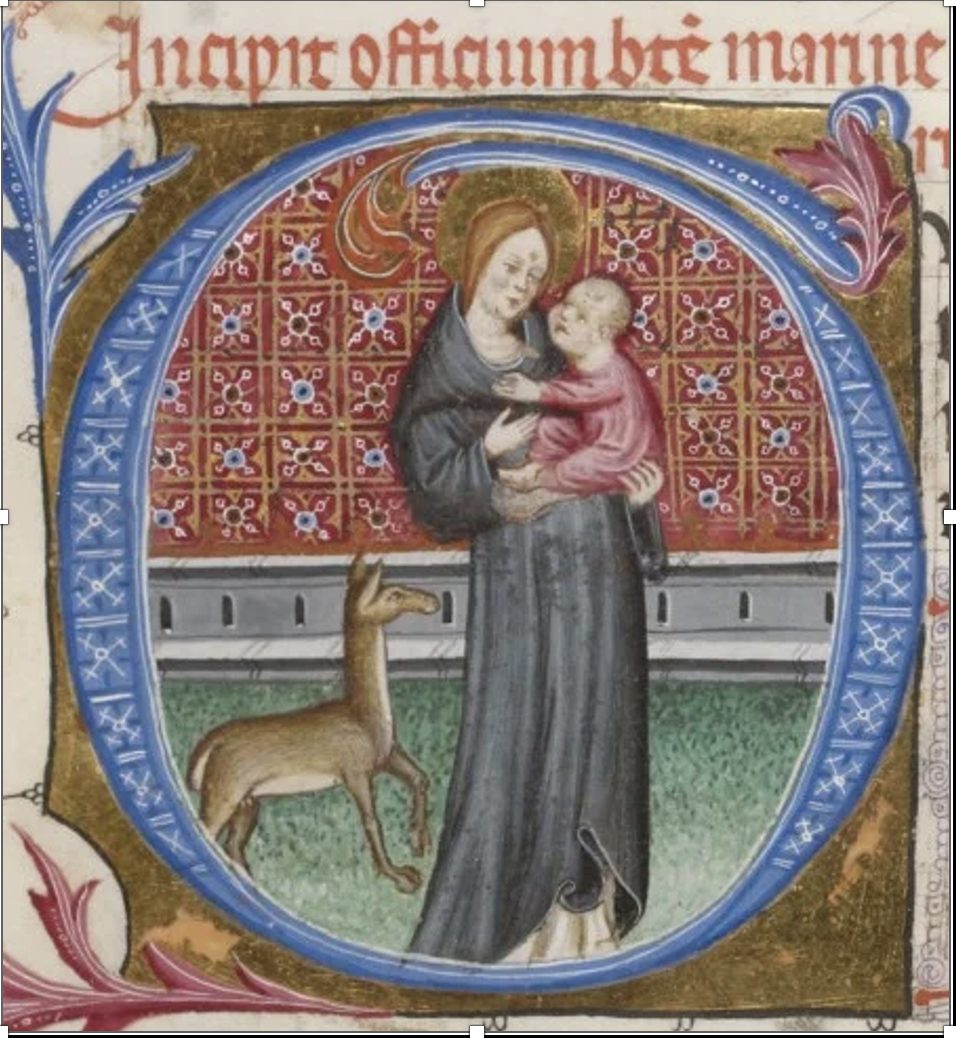
Saint Marina “the Disguised,” a female who entered a monastery dressed as a male; later as Marinos he was accused of fathering a child with a girl and expelled from the monastery for a period of time. He returned to the monastery and raised the child as his own; his birth gender was discovered only at his death. Paris, BnF MS Latin 5264, f. 74.
This lesson introduces students to the role of gender in the visual culture of the European Middle Ages (ca. 500–1500). Students will analyze how representations of women, men, and non-binary figures reflected and shaped ideas of power, spirituality, and social identity. Students will learn how contemporary scholars of gender studies provide interdisciplinary and intersectional frameworks for the examination of visual culture of the European Middle Ages. The goals of this lesson are 1.) to encourage students to consider how medieval images participated in the construction of gender norms; 2.) to explore non-normative representations and practices that resist stable categories of gender and sexuality; and 3.) consider how medieval people themselves understood gendered issues of sexuality, sanctity, and authority within prescribed social frameworks of a feudal economic system, religious hierarchy, and family.
To achieve these goals, we will also focus on a series of thematic shifts in the framing and discussion of gender and visual culture. These thematic shifts begin with an historical position or pedagogical method for teaching medieval European visual culture and expand students’ perspective by using a contemporary approach for premodern contexts. As you address these shifts with your students, be sure to discuss the risks and benefits of using modern terminology for premodern contexts. For example, an overarching question for the course might be, “How does a non-binary framework shift broader narratives of ‘medieval Europe’ in an art history survey course?”
By the end of the lesson, students will be able to:
- Identify key themes of gender in medieval art of Europe through images, primary sources, and secondary sources.
- Interpret how works of art and architecture reflect social hierarchies of medieval Christianity.
- Engage with scholarly debates around women’s patronage, representation, and voice in medieval European culture.
- Recognize how recent scholarship (feminist, queer, intersectional) reshapes our understanding of the medieval European past.
Background reading (recommended for instructors)
- Brigitte Kurmann-Schwarz, “Gender and Medieval Art,” chapter 6 in Conrad Rudolph, ed. A Companion to Medieval Art (Blackwell Companions to Art History, 2010).
- This historiographic review is divided into six sections (Women artists, Hildegard of Bingen and Herrad of Hohenbourg, Women patrons, The Role of Women in the Use of Devotional Images, Monastic Architecture for Women, and The Female Image in Romanesque and Gothic Art), and contains an extensive bibliography. A second, expanded edition was published in 2019.
- Carr, Annemarie Weyl. “Women as Artists in the Middle Ages: ‘The Dark is Light Enough’,” in Delia Gaze, A Concise Dictionary of Women Artists (2001).
- Weyl first published “Women as Artists in the Middle Ages” in the Feminist Art Journal in spring 1976; the essay does the first-wave feminist work of identifying women artists, exploring female experience, and reclaiming marginalized narratives. In subsequent publications, such as the version of the essay published in 2001, Carr explores female patronage. (Feminist Art Journal available on JSTOR; Concise Dictionary of Women Artists available on ProQuest Ebook Central, DOI: 10.4324/9780203058800-2)
- Different Visions, Visualizing Gender and Sexuality in the Middle Ages (Issue 8, 2022)
- Dedicated to art historian Rachel Dressler, this issue of Different Visions focuses on new research that engages with feminist art historical approaches within the fields of medieval art history and material culture studies. In keeping with Dressler’s commitment to demonstrating the breadth and flexibility of feminist critique, these essays expand the way we look at gender and sexuality in the study of medieval visual culture today.
- Gabrielle Bachowski, Were there Transgender People in the Middle Ages? The Public Medievalist, November 2019 (also the entire series, Gender, Sexism, and the Middle Ages)
- The Public Medievalist is an online, open-access project that brings medieval history and culture into public conversations, especially around pressing contemporary issues.
- “When it comes to gender, the popular imagination of the Middle Ages is a toxic fairy tale. Men and women had clear, unchanging gender roles, and there was no room for flexibility or queerness within that binary. Thankfully, none of this is true. The actual Middle Ages were little like modern preconceptions of them. And more, the people who use the Middle Ages to support retrograde misogynistic or transphobic agendas are badly mistaken.” – Bachowski, 2019
- Society for Feminist Medieval Scholarship’s Feminae database: https://smfsweb.org/feminae/
Timeline for 75 minute class meeting:
- Introduction (10 min): Gender as a category of analysis in art history.
- Sanctity and Gender (15 min): Saints, virginity, marriage, martyrdom.
- Authority, Power, and Patronage (15 min): Queenship, warriors, abbesses, female patrons.
- Bodies and Sexuality (15 min): Eve, mothers, temptresses, monstrous bodies
- Ambiguity and Fluidity (10 min): Cross-dressing saints, medieval queerness and queering the Middle Ages
- Discussion (10 min): Reflect on key works + historiography (Material Collective, Different Visions, The Public Medievalist).
Lesson Themes (for a 75-minute course, each of these themes can be addressed in 15 minutes or less…but if you have time, each of these themes, and the thematic shifts that follow, could be expanded to a standalone course meeting)
A slide show of the works to be discussed in the lesson plan.
Intro: Gender as a category of analysis in art history
Focus objects/images:
- The Personification of Nature Making Birds, Animals, and People, Ms. Ludwig XV 7 (83.MR.177), fol. 121v, about 1405, Unknown artist/maker (Slide 2 in slide deck)
As you frame the content of this lecture for students, introduce the fact that a medieval world in which men and women adhered to strict gender norms without question never existed. While the gender boundaries were real and pervasive, men and women often found ways to challenge those categories. Just as we have dispelled the nomenclature of “Dark Ages” when it comes to the medieval world, so must we also dispel the claim that trans and LGBTQ identities simply did not exist in the premodern world; this is demonstrably false, as we will see. In medieval art, gender is not simply a matter of depicting men or women, but a lens through which authority, identity, and social order are constructed and communicated. By asking how artworks represent, enforce, or challenge ideas of masculinity, femininity, and the spaces in between, art historians treat gender as a category of analysis (similar to class or race) rather than a fixed biological fact. This approach reveals how medieval visual culture both reflected and shaped cultural anxieties about lineage, authority, sexuality, and the body, and it opens space to recognize nonconforming or fluid expressions of identity, such as those dramatized in texts like the Roman de Silence or in images of cross-dressed saints.
The 13th-century Roman de Silence, written by the Norman poet Heldris of Cornwall, is a French Arthurian romance that explores themes of gender, identity, and power. The story has received renewed interest from scholars of gender because of its discussion of nature vs. nurture, cross dressing, and gender roles. The story follows Silence, the daughter of a noble family who is raised as a boy so that she could inherit her father’s lands. Disguised as male, Silence grows up excelling at chivalric pursuits (better even than the men around her) and becomes a celebrated knight. The narrative stages debates between allegorical figures: Nature (who insists Silence is female) and Nurture (who defends her social role as male).
Eventually, Silence is forced to reveal her “true” (birth-assigned) sex when the Queen falsely accuses her of seduction. King Evan strips Silence of knightly honors, restoring her female identity, and she is married off—an ending that reinforces patriarchal order, even as the text has vividly dramatized the instability of gender roles.
In this image from an early-15th century manuscript of Le Roman de la Rose, Nature (Latin: natura, natur–ae, f.) is personified as female. She stands at an anvil, raising a mallet, while a bird sits on the anvil. Nature is a metalsmith at her forge, a somewhat antithetical proposition when we think of the organic material that comprises the natural world; nevertheless, she is shown at her craft, creating the natural world and all in it by her hands. A human figure stands in line with other animals, gendered as male by the presence of a beard, but with gender neutral anatomy: the chest area where breasts would be found is covered by the figure’s hands and the genitalia are not present. The story of Silence and medieval images like this one widen students’ perspectives of attitudes towards medieval gender to include examples of cross-dressing and the social performance of gender norms outside of one’s assigned gender at birth.
Primary Sources
- Roman de Silence, University of Nottingham, Wollaton Library Collection, WLC/LM/6, early 13th century
Secondary Sources
- Bryan Keene, An Art History of Gender Identity and Sexuality, Smarthistory
Sanctity and Gender: Female mystics and saints, virginity and mystical marriage, martyrdom.
Focus objects/images:
- Hildegard of Bingen, Scivias (Rupertsberg, c. 1150s, produced under Hildegard’s supervision) (Slide 3)
- Hildegard of Bingen (1098–1179) was a German Benedictine abbess, mystic, composer, and polymath. Scivias (“Know the Ways”), her first major visionary work, is a richly illustrated theological text completed around 1151, in which she records and interprets a series of divine visions exploring creation, salvation, and the soul’s relationship with God. It combines theology, visionary imagery, and allegory, establishing her as both a spiritual authority and a creative innovator. In this image, Hildegard is receiving a vision and recounting her vision to Volmar, a monk who served as her secretary. The images were said to be painted under her direction.
- Barna da Siena, Mystic Marriage of Saint Catherine (c. 1340), Boston, Museum of Fine Arts. (Slide 4)
- The “mystical marriage” is a symbolic vision in which a saint, in this case Catherine of Alexandria, is united with Christ as a divine spouse, usually through the giving of a ring. This imagery represents the soul’s spiritual union with God, emphasizing devotion, purity, and eternal commitment. It also allows a chaste woman to engage in a spousal, gendered relationship with Christ as the bridegroom and Saint Catherine as the bride.
- Saints Lucy and Agatha, Rafael Vergós, Spain, c. 1500 (Slide 5)
- Saints Lucy of Syracuse and Agatha of Catania, two early Christian virgin martyrs, were central figures in medieval devotion, especially as models of steadfast faith in the face of violent persecution. Their martyrdom stories emphasize extreme assaults on the female body: Lucy is said to have had her eyes gouged out before being killed, while Agatha endured the mutilation of her breasts during torture. These gruesome details, while shocking, underscored their inviolable chastity and spiritual triumph, reframing bodily violence as a site of sanctity rather than shame. In medieval art and literature, such imagery reinforced ideals of virginity, sacrifice, and the transcendence of the soul over the suffering of the flesh, while also exposing cultural anxieties about women’s bodies, sexuality, and power.
Primary sources:
- Jacobus de Voragine’s Legenda aurea (13th-century compilation of lives of the saints, especially lives of Sts. Lucy, Agnes, Agatha, Catherine)
- Passion of St. Perpetua and Felicitas (early but influential for medieval female martyrdom narratives).
- Hildegard of Bingen, Scivias (12th-century text of Hildegard’s visions titled Scivias, a shortened version of “Sci vias Domini,” or “Know the way of the Lord”)
Secondary Sources
- Caroline Walker Bynum, Holy Feast and Holy Fast: The Religious Significance of Food to Medieval Women (esp. chapters on virginity/martyrdom).
This theme encourages us to consider how sanctity was imagined and represented differently for women and men, and how medieval European visual culture constructed models of holy femininity.
In the European Middle Ages, sanctity was not only a spiritual category but also a profoundly gendered one. Male sanctity was often tied to the practice of imitatio Christi, or the imitation of Christ; for example, Saint Francis of Assisi interpreted this practice to mean physical and spiritual imitation, taking on a vow of poverty and chastity. Pious women were expected to be chaste. Female saints, such as Catherine of Alexandria, Agnes, and Margaret were celebrated for their virginity, endurance of suffering, and resistance to secular or familial authority (but only when their resistance was connected to their piety). Their bodies, often subjected to violence in hagiographic narratives, became sites of both vulnerability and triumph (see representations of Saints Lucy and Agatha who hold the parts of their bodies that had been removed through torture and martyrdom). Medieval image makers visualized female sanctity through iconography that emphasized the cardinal virtues of prudence, justice, temperance, and fortitude, and theological virtues such as faith, hope, and charity.
Virginity was understood as a form of sacred power predominantly attributed to women, allowing them to transcend ordinary gender roles and align themselves with divine authority. Nowhere is this more apparent than in the visual culture of the Marian cults of late medieval western Europe, which celebrated the Virgin Mary as a sacred queen, vessel, and nurturer, as described in this thematic essay from the MET’s Heilbrunn Timeline of Art History. Though physically maintaining their chastity, through mystical marriage, nuns could be spiritually wed to Christ, often wearing rings to signify this act.
In this theme, we are addressing the physical state of the body through virginity and martyrdom. In 1987’s Holy Feast, Holy Fast: The Religious Significance of Food to Medieval Women, Carolyn Walker Bynum presented her framework for viewing female piety through an element of life that was often in their control: food and domestic activity. Fasting was the physical manifestation of piety, and was something that medieval women could have autonomy over. This provides an additional context and locus of authority in the lives of medieval women, especially nuns.
Authority, Power, and Patronage: Queenship, abbesses and cloisters, and women artists and patrons, warriors.
Focus objects/images:
- Tomb effigy of Eleanor of Aquitaine (1137–1204), located in the Royal Abbey of Fontevraud (founded 1101) (Slides 6, 7, 8)
- Eleanor married Henry II in 1152, thus entering the Plantagenet family. Although the Abbey of Fontevraud was founded in 1101, it was Eleanor’s Plantagenet patronage, and the burial of her family there, that established Fontevraud as a Royal Abbey. The abbey was Eleanor’s home in the final years before her death in 1204, a refuge for the widowed queen. Patronage of abbeys by royal and noble women created a potential political sanctuary for them and an option for autonomy if they chose to remove themselves from public life.
- Portrait of Blanche of Castile (1188–1252), Moralized Bible (Paris, c. 1230) (Slide 9)
- Smarthistory video
- From 1226–1234, French queen Blanche of Castile served as regent for her young son, Louis IX, after the death of her husband, King Louis VIII. During that time, she fought off potential usurpers who were trying to win back the lands that they had lost to Louis VII a generation before. During Blanche’s role as regent for Louis IX, she negotiated treaties, royal marriages, and defended the crown against a noble uprising. An extraordinary woman, Blanche demonstrates that a female gender identity, though often a hindrance in positions of authority, was not an insurmountable impediment. Her son, later canonized as Saint Louis, recognized Blanche’s influence as instrumental in keeping the realm intact.
- Eleanor of Castile (1241–1290) crosses (Slide 10)
- The Eleanor crosses commemorate the road that her body took through England before her burial at Westminster Abbey. Edward was devastated after her death at age 49, and in order to commemorate his vast grief, he had crosses erected at each of the twelve places where Eleanor’s coffin had rested overnight on the way south from Lincoln to her final resting place at Westminster Abbey. Three crosses remain, at Geddington in Northamptonshire, Hardingstone near Northampton and Waltham Cross in Hertfordshire. Pilgrims visited the crosses as they walked the trail to commemorate Eleanor’s funerary procession. The public outpouring of grief is an example of the political and social power wielded by queens, even in death.
- Nonnenarbeiten (works by nuns for their own use) (Slide 11)
- Vision of Saint Bernard, (Blood Crucifix), Cologne, Schnütgen Museum, Inv. Nr. M340, Lower Rhine, 14th century.
- The Heart on the Cross, Eichstätt, St. Walburg, anonymous nun of the late 15th century
- Jeffrey Hamburger’s Nuns as Artists: The Visual Culture of a Medieval Convent (1997) challenges the long-standing assumption that cloistered nuns were passive consumers of art rather than active participants in its creation and meaning. Focusing on late medieval German convents, Hamburger demonstrates that nuns not only commissioned, used, and interpreted devotional images, but in some cases also produced them, integrating art into their spiritual practices and communal identity. These two works made by and for women are examples of the iconography commonly found in Nonnenarbeiten. Hamburger’s book is important because it highlights gender as a central category of analysis in art history and expands our understanding of who could be considered an “artist.”
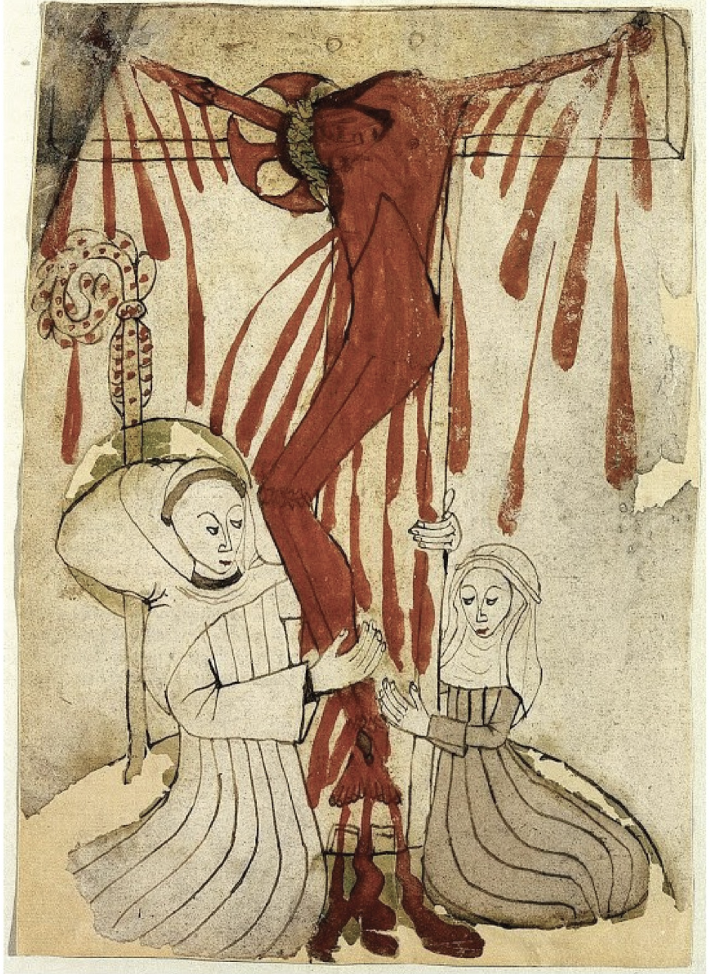
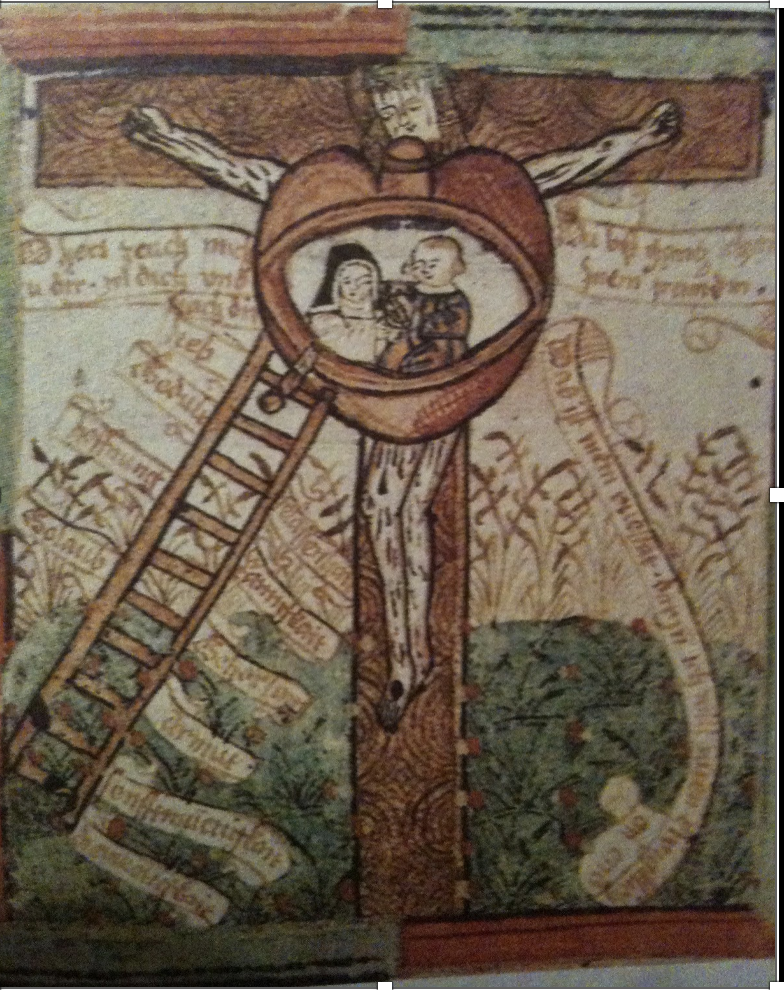
(L) Vision of Saint Bernard, (Blood Crucifix), Cologne, Schnütgen Museum, Inv. Nr. M340, Lower Rhine, 14th century. (R) The Heart on the Cross, Eichstätt, St. Walburg, anonymous nun of the late 15th century
- Birka grave Bj 581, 10th century grave located in Birka, Sweden (Slide 12)
- This grave was first documented in 1889, when the occupant was labeled as male. The Viking warrior was buried along with weapons, a strategy game with game pieces, and other grave goods. A 2014 osteological analysis and a 2017 DNA analysis proved that the figure was indeed female. This 21st-century announcement was met with controversy and some pushback. Dick Harrison, a Swedish historian at Lund University, was quoted in a New York Times article, saying, “What has happened in the past 40 years through archaeological research, partly fueled by feminist research, is that women have been found to be priestesses and leaders, too…This has forced us to rewrite history.”
Primary Sources
- Herrad of Landsberg, Hortus Deliciarum (12th-century illustrated encyclopedia by an abbess). Herrad (c. 1130–1195) is best known as the compiler and author of the Hortus Deliciarum (“Garden of Delights”), an illuminated encyclopedia created for the education of the nuns in her abbey. The work gathered theology, biblical exegesis, history, literature, and over 300 illustrations into a richly visual teaching tool, reflecting both Herrad’s intellectual leadership and the cultural vibrancy of women’s monastic communities. Herrad also included a self-portrait in the Hortus.
- Letters of Hrotsvitha of Gandersheim (10th-century canoness/playwright). These letters from an educated nun to the patrons she is working for explain her process and celebrate her patrons. In these letters, she is often self-deprecating, diminishing her accomplishments; however, they reveal the intellectual life possible for women in 10th-century abbeys.
Secondary Sources
- Tracy Chapman Hamilton and Mariah Proctor-Tiffany, eds. Moving Women, Moving Objects (400-1500). Maps, Spaces, Cultures, Vol. 2. Foreword by Joan A. Holladay. Leiden; Boston: Brill, 2019.
- This edited volume investigates how aristocratic and royal women in medieval Europe (500-1500) used objects, not merely as passive possessions but as active elements in crafting their identity, networks, and power. The book situates these women in motion (through marriage, diplomacy, pilgrimage, widowhood) and shows that their travels or relocations often involved transporting objects (jewelry, manuscripts, seals, trousseaux, icons, clothes, etc.) that carried symbolic, familial, political, and devotional meanings. The contributors reveal a material culture that both reflected and shaped gendered structures of power, identity, and belonging.
- Therese Martin, Queen as King: Politics and Architectural Propaganda in Twelfth-Century Spain. The Medieval and Early Modern Iberian World, Vol. 30. Leiden; Boston: Brill, 2006.
- Madeline Caviness, Visualizing Women in the Middle Ages: Sight, Spectacle, and Scopic Economy. Middle Ages Series. Philadelphia: University of Pennsylvania Press, 2001.
- Jeffrey Hamburger, Nuns as Artists: The Visual Culture of a Medieval Convent. Berkeley: University of California Press, 1997.
One way to tell the story of women and power in the European Middle Ages is through their patronage: what they commissioned, what they owned, how they gave gifts and what they were gifted, and sites (like abbeys) that they funded. While the European Middle Ages is often remembered as a patriarchal society, women wielded remarkable forms of authority and power, especially in religious and artistic contexts. Queens shaped dynastic politics through marriage alliances and cultural patronage, commissioning manuscripts, churches, and luxury objects that signaled both piety and status. Figures like Queen Blanche of Castile in 13th-century France appear not only as political actors but also as patrons represented in manuscripts such as the Moralized Bible, where her image asserts maternal and monarchical authority simultaneously.
Religious women also occupied positions of influence. Abbesses such as Uta of Niedermünster and Herrad of Landsberg directed the production of illuminated codices like the Uta Codex and the Hortus Deliciarum, works that functioned as teaching tools and theological statements. Their role as intellectual leaders extended to architecture, relic collection, and the shaping of devotional practices within their communities. Through patronage, abbesses and countesses created visual legacies that affirmed their leadership and spiritual insight.
Objects like portable altars or richly decorated reliquaries commissioned by noblewomen remind us that female patrons exercised creative agency in shaping the material culture of devotion. Through movement of these objects, women mapped their own authority; we see their influence on medieval networks in objects like the Eleanor crosses, stone monuments that track the movement of Eleanor of Castile’s funeral procession stopped on the way from Lincoln to Westminster. In this theme, we consider how women’s power was constructed visually and materially: how images reinforced or challenged gender norms, how sacred and secular authority intersected, and how patronage became a vehicle for female voices in medieval art.
At the same time, the cloister provided a gendered sacred space where nuns cultivated collective sanctity and pursued intellectual and creative talents, as in the works of Hrotvit of Gandersheim, or the nonnenarbeiten of Saxony, consisting of manuscripts, textiles, and other objects. Cloisters ask us to reflect on how sacred space could both restrict and empower women in shaping religious life and visual traditions.
A final category of authority and gender can be seen in the warrior class. Knights were depicted as male paragons of martial valor, honor, and chivalric virtue. Illuminated manuscripts such as the Maciejowski Bible portray knights in heroic battle, often juxtaposing secular bravery with religious devotion, signaling the interwoven nature of physical and moral excellence in male identity. Yet the Middle Ages also produced examples that disrupted traditional gender norms. Famous examples of women dressing as men to join the battlefield include Joan of Arc (1412–1431) and Matilda of Canossa (1046–1115). Archaeological discoveries, such as the Birka Viking grave whose DNA evidence revealed a female warrior, demonstrate that women sometimes participated in martial roles long assumed to be exclusively male. Medieval depictions of women in arms complicate visual and textual notions of gendered physicality and authority.
Bodies and Sexuality: Eve, mothers, temptresses, monstrous bodies.
Focus objects/images:
-
- Eve by Gislebertus, c. 1130, originally located on the north transept portal of Saint-Lazare at Autun. (Slide 13)
- Bestiary images: mermaids, sirens, lamiae (sources on slide) (Slide 14)
- Visitation grouping, Reims Cathedral, 1211–35 (Slide 15)
- Anna Selbdritt, Free Library of Philadelphia, Lewis E M 42:29 (Slide 16)
- “Anna Selbdritt” (German, “Anne herself the third”) is an iconographic type in Christian art showing three generations: Saint Anne (the grandmother), her daughter Mary, and her grandson Jesus. Sometimes Mary is shown as a child sitting on Anne’s lap, and sometimes standing beside her or leaning on her. Anne usually holds or supports both Mary and Jesus in ways that emphasize her maternal role.
- Vierge ouvrante, Musée du Cluny, late 14th or early 15th century (Slide 17)
-
- A Vierge ouvrante (French, “Opening Virgin”) is a special kind of medieval devotional sculpture of the Virgin Mary that can be physically opened like a triptych. From the outside, it appears as a statue of Mary (often enthroned, sometimes holding the Christ Child). But the figure is hinged; when opened, the inside reveals painted or carved scenes (commonly the Trinity, the Coronation of the Virgin, or narrative cycles of Christ’s life). The imagery makes Mary’s body a symbolic space. Her outer form conceals and reveals sacred mysteries, inviting reflection on the female body as vessel, mediator, and site of divine revelation.
Primary Sources
- Bestiary entries on hybrid/monstrous women (mermaids, sirens, lamiae)
Secondary Sources
- Melissa R. Katz, “The Non-Gendered Appeal of Vierge Ouvrante Sculpture: Audience, Patronage, and Purpose in Medieval Iberia,” in: Reassessing the Roles of Women as ‘Makers’ of Medieval Art and Architecture, ed. Therese Martin (Brill, 2012).
- Carolyn Walker Bynum, Jesus as Mother: Studies in the Spirituality of the High Middle Ages, 1982.
- Jesus as Mother is a collection of essays by Caroline Walker Bynum examining religious texts from the 12th- and 13th-centuries. It explores how medieval spirituality used feminine imagery, especially images of Jesus as mother, and investigates how these metaphors relate to gender, authority, religious life, and community. She places these image-usages in relation to questions: what happens when male religious figures adopt “feminine” imagery for biblical figures or authority structures (e.g., abbots, Christ)? How does that affect conceptions of leadership, care, community? How are ideas of gender (masculine/feminine) socially constructed in these spiritual contexts?
Medieval visual culture often constructed gendered ideas through the representation of the body, sexuality, and morality. Women’s bodies were frequently coded as sites of temptation, sin, or divine exemplarity, while male bodies were framed in relation to strength, virtue, or spiritual discipline. Biblical figures such as Eve embodied the dual threat and promise of female sexuality: she was both the source of humanity’s fall and a vehicle for salvation, depending on context. This sculpted relief by Gislebertus depicts Eve reaching for the apple (on a branch being bent towards her by a clawed hand) at the moment of transgression, emphasizing her corporeal female form as morally charged.
In medieval Christianity, the Virgin Mary embodied a paradox at the heart of Christian thought about women and sexuality: she was both the ideal mother and perpetually virginal. Her status as virgo et mater elevated her above ordinary women, whose sexuality was often tied to sin. By modeling a form of motherhood detached from sexuality, Mary offered an archetype of purity and spiritual devotion, shaping medieval ideals of female virtue while also reinforcing ambivalence toward women’s embodied sexuality. Images of the Virgin Mary used in private devotion found an audience for all Christians, regardless of gender. Some public images, such as the sculptural grouping at Reims, emphasize her role as an ideal mother.
Temptresses, witches, or monstrous women similarly appear in marginalia, sculpture, and stained glass, visually encoding anxieties about female desire and the dangers of transgression. These images are rarely purely fantastical; they reflect societal beliefs about gender, control, and the potential power of women’s bodies. Monstrous hybrids—such as sirens, lamias, or hags—often serve as cautionary figures, demonstrating the consequences of violating norms of sexuality and propriety.
At the same time, nuns and other women produced devotional works that asserted corporeal agency in more constructive ways. Liturgical textiles, illustrated psalters, and devotional diptychs reveal how women engaged with their own embodiment in the service of piety. The Vierge ouvrante sculptures and Anna Selbdritt imagery focus on Christ’s matrilineage and the Virgin as sacred vessel–her female form able to hold within it the substance of the Trinity. This theme invites students to explore the intersection of visual form, moral ideology, and bodily representation, asking how medieval society interpreted and controlled sexuality through images, and how these representations shaped broader cultural ideas about women and men.
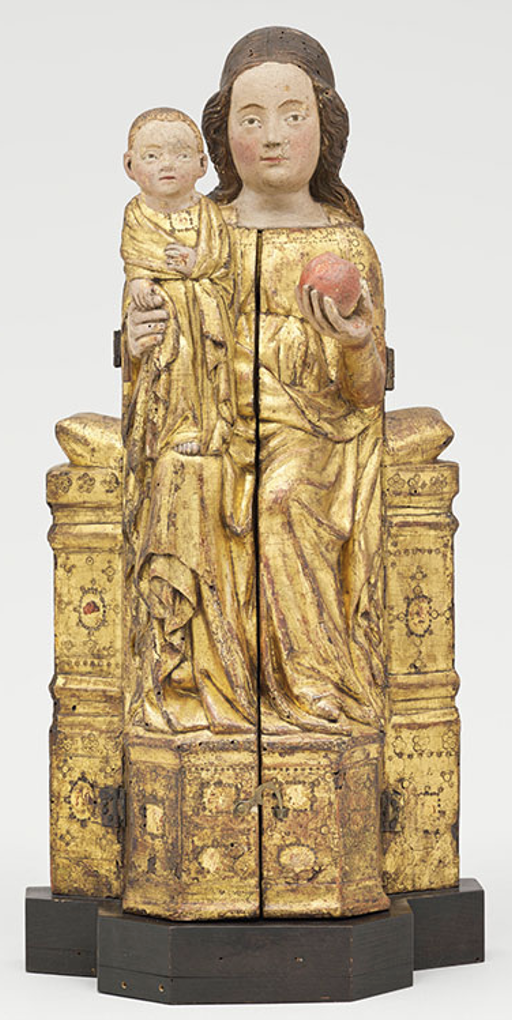
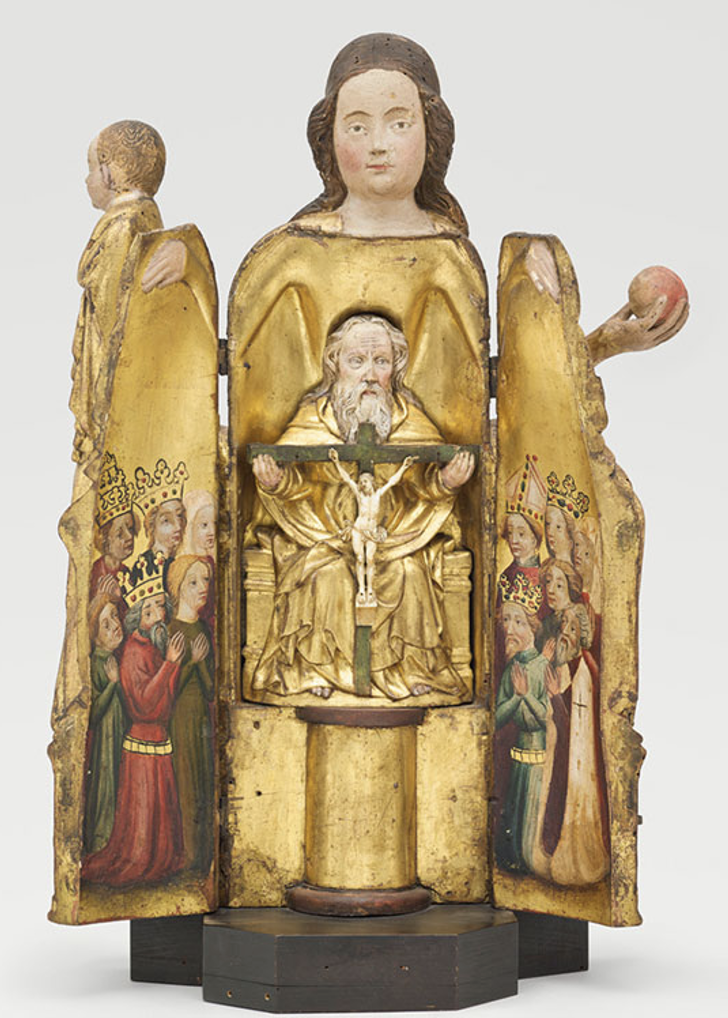
Vierge ouvrante, Musée du Cluny, late 14th-early 15th c.
Gender Fluidity and Ambiguity: Cross-dressing saints, allegorical figures, medieval queerness (and queering the Middle Ages).
Focus objects/images:
- Side wound, Bonne of Luxembourg’s BoH, c. 1345–49 (Slide 18)
- Side wound illumination from L’image du Monde of Gossouin de Metz, 13th century (Slide 19)
- Images of Marinos the Monk and Saint Eugenia (sources in slides) (Slides 20, 21, 22, 23)
Primary Sources
- Life of St. Eugenia (cross-dressing saint). A translation from Aelfric’s Lives of Saints can be found in Wikisource.
- Life of St. Marinos/Marina (female saint who lived as a monk). Translation can be found in Fr. Maximos Constas, “The Life of St. Mary/Marinos: Introduction and Translation” (from Holy Women of Byzantium, Dumbarton Oaks, 1998).
Secondary Sources
- Dr. Maeve K. Doyle, “Mysticism and queer readings of Christ’s Side Wound in the Prayer Book of Bonne of Luxembourg,” in Smarthistory, June 29, 2020. https://smarthistory.org/jean-le-noir-bourgot-miniature-of-christ-wound-passion-prayer-book-bonne-luxembourg/.
- Roland Betancourt, Byzantine Intersectionality: Sexuality, Gender, and Race in the Middle Ages (esp. chapters on queer readings).
-
Robert Mills, “Visibly Trans?: Picturing Saint Eugenia in Medieval Art,” https://doi.org/10.1215/23289252-7090017
- M. W. Bychowski, “The Authentic Lives of Transgender Saints: Imago Dei and imitatio Christi in the Life of St. Marinos the Monk,” in Trans and Genderqueer Subjects in Medieval Hagiography, 2021, pp. 245-266.
Although the European Middle Ages is often framed as rigidly hierarchical and binary in its understanding of gender, its visual and textual cultures reveal numerous moments of fluidity, ambiguity, and transgression. Early Christianity has many examples of women who dressed as men to protect their virginity or chastity, or to enter exclusively male spaces, such as monasteries and armies. Saints such as Eugenia, Marinos, and Thecla were depicted disguising themselves in male clothing in order to access spiritual authority, escape persecution, or enter monastic life. These narratives circulated in hagiographic manuscripts, where illuminations sometimes emphasized the saint’s dual gendered identity, complicating conventional categories of male and female.
Allegorical figures in manuscripts and sculpture also invited more flexible readings of gender. Personifications of abstract concepts such as Synagoga, Ecclesia, and Lady Philosophy blurred the line between the human body and symbolic meaning, making gender a vehicle for theological and moral ideas rather than a fixed identity. Images of Christ’s wounds from the Crucifixion, especially the side wound, have drawn comparisons to medieval images of the vulva and vaginal opening from medieval medical treatises. When these manuscripts, such as Bonne of Luxembourg’s Book of Hours and L’Image du monde of Gossouin of Metz, were used in private devotion, they may have been ritually touched, prodded, or kissed, a tactile ritual that in the dual readings of the disembodied wound could have evoked a feeling of being embraced or surrounded by Christ’s presence.
Contemporary scholarship like that of Roland Betancourt (who is quoted above in the introduction) and Maeve Doyle, highlights how medieval texts and images can be read through the lens of queer studies. By attending to moments of ambiguity (figures who cross dress, allegories that destabilize binary gender, or devotional objects that invite intimate, tactile encounters), students can begin to see the Middle Ages not only as a period of constraint but also as one of imaginative experimentation. According to Doyle, “queering” the Middle Ages “means questioning assumptions of heterosexual and cisgender normativity in the past, providing a critique of modern scholarship in the process.”
This theme opens space to consider how non-binary and queer identities might find resonance in medieval art, asking how visual culture both enforced and unsettled gender norms, and how ambiguity itself functioned as a site of meaning.
Perspective Shifts: Concluding Discussion
From Binary Roles to Gender Diversity
Traditional historical surveys and popular culture may present the Middle Ages in Europe as highly rigid in its social classifications, from the feudal system with its three estates to medieval gender as a strict division between “male warriors” and “female wives/nuns.” This lesson reframes the period by emphasizing figures who disrupted or exceeded those categories, revealing a medieval fascination with gender ambiguity and transformation.
From Saints as Gendered Icons to Saints as Gender-Expansive Figures
Saints’ lives and their artistic representations can include elements of gender crossing or ambiguity. Re-reading these through a non-binary lens highlights both the instability of gender and the medieval theological fascination with bodies in flux. Even Christ’s body and the wounds of the Crucifixion can be interpreted as gender-ambiguous.
From “Timeless” Medieval Gender to Historical Specificity and Fluidity
Students will consider how medieval categories of sex and gender operated differently from modern frameworks, but also how they reveal long-standing cultural engagement with gender diversity.
From Stable Bodies to Shifting Identities
Rather than assuming medieval bodies were fixed in meaning, this shift highlights how miraculous transformations, cross-dressing, and ambiguous iconography reveal gender as dynamic and unstable.
A note on teaching this content in the present moment
Teaching the European Middle Ages through the lens of gender, sexuality, and power has never been purely about the past. In the present moment, when diversity, equity, and inclusion initiatives are being challenged or eliminated across many American campuses, it can feel risky or isolating to center questions of gender, queer identity, and marginalized voices in the classroom. Yet this is precisely when such work is most vital.
Medieval art and culture offer rich opportunities to examine how identities were constructed, contested, and represented in ways that still resonate today. Far from being anachronistic, discussing gender and sexuality in the Middle Ages demonstrates to students that these categories have always been shaped by history and visual culture. It reminds us that ideas of “normal,” “natural,” or “traditional” are themselves historical inventions.
For educators, this can also be a moment of solidarity. You are not alone in navigating these tensions. Building classrooms where students feel empowered to think critically about representation, whether of medieval saints, queens, or gender-nonconforming figures, remains a deeply meaningful act. This lesson plan aims not only to introduce key works of medieval art, but also to affirm the value of inclusive, historically grounded pedagogy in challenging times.
A useful starting activity is to ask students to examine two or three medieval images without identifying their subjects or providing extensive historical context. Students can describe what they see, identify visual indicators of gender and social status, and develop questions about the relationships represented. Many students arrive in medieval art with some familiarity with depictions of medieval men and women (knights, kings, queens, monks, nuns, etc.), and you can build upon or dispel stereotypical points of reference. After introducing relevant historical context, students can revisit their initial interpretations and consider how their understanding has changed. Small-group comparisons of images and texts can further encourage students to recognize differences between representations of gender and the experiences of historical individuals.
In introductory courses, these activities can emphasize observation, comparison, and the development of historical questions. In upper-level courses, students might examine historiographical approaches to medieval gender, consider the relationship between gender and other forms of social identity, or investigate how scholars use fragmentary evidence to reconstruct experiences that are not well documented. The development of feminist art history and gender studies has shifted attention from identifying exceptional medieval women to examining how gender shaped the production, patronage, reception, and interpretation of medieval visual culture. Across course levels, the central objective is to encourage students to approach medieval gender as a subject of historical inquiry rather than a collection of familiar stereotypes.