Reframing Femininity: From Courtly Ideals to Contemporary Resistance
FIRST THINGS FIRST . . . .
This lesson plan introduces students to the shifting visual constructions of femininity in Chinese art, from imperial court painting to contemporary multimedia practices. Through close analysis of images, objects, and artistic strategies, students will explore how representations of women have historically functioned as tools of moral instruction, social regulation, and aesthetic idealization, while also examining how modern and contemporary women artists actively reclaim the female body as a site of agency, resistance, and self-definition. By situating Chinese case studies within broader feminist and transnational art historical frameworks, this lesson equips students with critical tools to analyze gendered imagery across time, media, and cultural contexts.
In this lesson, femininity refers to the visual and cultural conventions through which ideas about women, gender roles, and social behavior have been represented and interpreted in art. Rather than treating femininity as a universal category, the lesson emphasizes its historical variability and its role in shaping and challenging power relations within visual culture.
The goals of this lesson plan are to:
- Familiarize students with key representations of women in Chinese art from the imperial period to the present.
- Investigate how visual conventions, patronage, and the gaze shaped ideals of female aesthetics and virtue.
- Analyze how women artists have contested, revised, and re-performed femininity through modern and contemporary practices.
- Provide instructors with visual examples and discussion frameworks that support broader conversations on gender, power, and representation in art history courses.
Learning Objectives:
Topics in this lesson plan can be incorporated into undergraduate courses in Art History, Asian Art, Gender Studies, or Visual Culture. Through this lesson, students will be able to:
1) Identify visual conventions used to construct femininity in Chinese art across different historical periods.
2) Describe how gender roles were reinforced through court painting, portraiture, and elite patronage systems.
3) Analyze how modern and contemporary women artists challenged dominant representations through self-representation, material experimentation, and performance.
4) Compare Chinese case studies with transnational feminist art practices to understand the global circulation of feminist visual strategies.
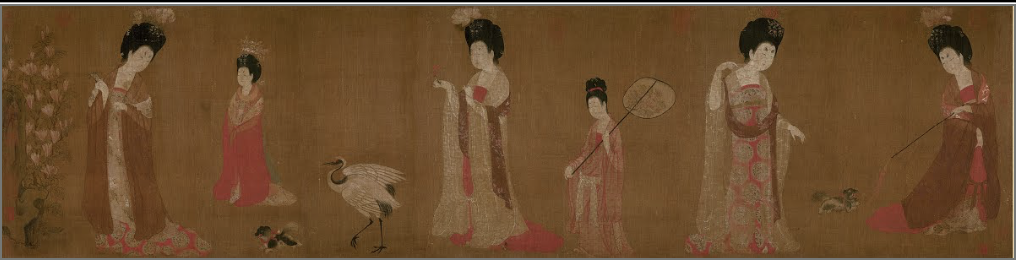
This lesson explores how femininity has been visually constructed, codified, and challenged in Chinese art, tracing a trajectory from imperial court culture to contemporary feminist practice. The aim is to equip students with the skills to critically analyze visual representations of women, assess their historical functions, and identify strategies of resistance and redefinition in art across time and media. The discussion begins with canonical works such as Nüshi zhen tu (Admonitions of the Instructress to the Court Ladies) and Zanhua shinü tu (Court Ladies Wearing Flowered Headdresses), which articulate Confucian ideals of virtue, status, and beauty through refined figural imagery. These paintings were produced and circulated within elite circles. They functioned as moralizing visual texts, prescribing gendered behavior and reinforcing hierarchical social structures.
By situating these works within the frameworks of gendered patronage and the male gaze, students will assess how visual conventions shaped the perception and agency of women in the imperial realm. This historical foundation is then set in dialogue with the artistic strategies of modern and contemporary artists such as Pan Yuliang (1895–1977), Yin Xiuzhen (b. 1963), Cao Fei (b. 1978), and Yushi Li (b. 1991). Pan’s negotiation of modernism and Orientalism, Yin’s transformation of domestic and urban materials, and Cao’s creation of digital performance spaces serve as case studies in reclaiming visibility, authorship, and bodily autonomy.
The lens then broadens to transnational perspectives, drawing parallels to the sensuous abstraction of Georgia O’Keeffe (1887–1986) and the immersive installations of Yayoi Kusama (b.1929). These comparative case studies reveal how feminist iconography travels across cultural and temporal boundaries, contributing to a new transnational feminism in visual culture.
Students will engage with scholarship by Louise Edwards, Hui-shu Lee, Phyllis Teo, and others, alongside digital archives such as the Asia Art Archive (AAA) Collections. Through close visual analysis, thematic discussion, and curatorial exercises—including speculative exhibition proposals responding to the #MeToo movement—students will interrogate the intersections of image, ideology, and power.
By the end of the session, students will be able to recognize and describe key artistic strategies for constructing and contesting femininity in Chinese art, connect historical and contemporary works through shared feminist frameworks, and apply comparative perspectives to reframe canonical art histories. In doing so, the lesson recovers overlooked female voices and demonstrates how feminist strategies can transcend medium, geography, and historical period to remain urgently relevant today.
BACKGROUND READING
Gendered Patronage and Imperial Imagery
- Hui-shu Lee (2010), Empresses, Art, and Agency in Song Dynasty China, pp. 3–22. Seattle: University of Washington Press.
- Luk Yu-ping (2016), “The Empress’ Dragon Crown,” Orientations, 47(3): 88–93.
- Jerome Silbergeld (1982), “Chinese Painting Style: Theory and Practice,” Artibus Asiae, 43(4):287–322.
Visibility and Self-Representation
- Louise P. Edwards (1993), “Representations of Women and Social Power in Eighteenth-Century China: The Case of Wang Xifeng,” Late Imperial China, 14(1): 34–59.
- Ellen J. Laing (1990), “Notes on Ladies Wearing Flowers in their Hair,” Orientations, 21(1/2): 32–39.
- Julia F. Andrews (1994), “Painters and Politics in the People’s Republic of China, 1949–1979,”Berkeley: University of California Press.
Challenging the Male Gaze
- Kam Louie and Louise Edwards (1994), “Chinese Masculinity: Theorising ‘Wen’ and ‘Wu’,” East Asian History, 8: 135–148.
- Lara C. W. Blanchard (2009), “Huizong’s New Clothes: Desire and Allegory in Court Ladies Preparing Newly Woven Silk,” Positions: East Asia Cultures Critique, 17(2): 299–336.
* John Berger (1972), Ways of Seeing. London: Penguin Books.
Transnational Dialogues
- Griselda Pollock (1988), “Feminist Interventions in the Histories of Art,” in Vision and Difference: Femininity, Feminism and Histories of Art, pp. 1–21. London: Routledge.
Modern and Contemporary Feminist Interventions
- Phyllis Teo (2010), “Modernism and Orientalism: The Ambiguous Nudes of Chinese Artist Pan Yuliang,” New Zealand Journal of Asian Studies, 12(2): 65–80.
- Phyllis Teo (2010), “Alternative Agency in Representation by Contemporary Chinese Women Artists,” Asian Culture and History, 2(1): 3–13.
FURTHER RESOURCES
Research Institutions & Curatorial Projects
- Tate Research Centre Asia – “Gender in Chinese Contemporary Art” (2018) • National Museum of Women in the Arts (NMWA) :https://nmwa.org/
- Elizabeth A. Sackler Center for Feminist Art – Feminist Art Base (Brooklyn
Museum): https://www.brooklynmuseum.org/eascfa/feminist_art_base
Asia Art Archive (AAA) Collections
- Six Contemporary Chinese Women Artists: https://aaa.org.hk/en/collections/search/library/six-contemporary-chinese-women-artists
- Women’s Approach to Chinese Contemporary Art: https://aaa.org.hk/en/collections/search/library/womens-approach-to-chinese contemporary-art-45799
Multimedia Resources
- Google Arts & Culture – “Seeing Gender” (Asian Art Museum):https://artsandculture.google.com/story/seeing-gender-asian-artmuseum/twXRWK0zCU8LIw?hl=en
The key ideas of this lecture can be explored in one hour and fifteen minutes through a variety of examples listed below by themes and case studies, including:
Key Themes:
- Gendered Patronage and Power: from imperial commissions to women as patrons and curators.
- Visibility and Self-Representation: depictions of women vs. women’s self-depictions.
- Challenging the Male Gaze: reinterpreting female imagery in traditional and contemporary contexts.
- Transnational Feminist Dialogues: linking Chinese artists, such as Pan Yuliang (1895–1977) and Yin Xiuzhen (b.1963), with international figures Georgia O’Keeffe (1887 – 1986) and Yayoi Kusama (b.1929).
- Curatorial and Activist Responses: imagining exhibitions in the wake of #MeToo, addressing gender inequality and visibility .
Key Artists and Case Studies:
Pan Yuliang (1895–1977) – One of the first Chinese women to study in France; merged modernist techniques with Chinese painting, confronting both Orientalist and patriarchal narratives.
- Yin Xiuzhen (b.1963) – Uses domestic fabrics and found urban materials to reflect on memory, gendered labor, and globalization.
- Cao Fei (b.1978) – Creates immersive digital worlds and performance-based works that interrogate identity, technology, and contemporary life.
- Georgia O’Keeffe (1887–1986) – Known for sensuous floral abstractions and landscapes, challenging gendered interpretations of subject matter.
- Yayoi Kusama (b.1929) – Fuses personal psychology with immersive environments, redefining female authorship and visibility in global contemporary art.
- Yushi Li (b.1991) – Contemporary photographer exploring desire, gaze, and the politics of representation.
Click for images: Slide Presentation
GLOSSARY
- Male Gaze A feminist theory term introduced by Laura Mulvey (1975) to describe how visual culture is shaped by masculine perspectives; originally from film theory, now widely applied to visual art.
- Self-representation: Artistic strategies where artists depict themselves to assert identity, authorship, or agency.
- #MeToo: Contemporary feminist movement initiated by Tarana Burke in 2006, highlighting gender-based violence and inequality; in China, it has also sparked debates and artistic responses addressing women’s visibility and rights in cultural spaces.
- Transnational Feminism: Feminist frameworks that examine gender in relation to global power structures, migration, and cultural exchange.
- Gendered Patronage: The influence of gendered social structures on patterns of art commissioning, production, and display.
IMAGE LIST
- Nüshi zhen tu (Admonitions of the Instructress to the Court), Att Gu Kaizhi (ca. 345 – 406), 5th – 7th Century, British Museum.
- Zanhua shinü tu (Court Ladies Wearing Flowered Headdresses), Att Zhou Fang (ca. 730 – 800), Handscroll, ink and color on silk, Liaoning Provincial Museum.
- Pan Yuliang, Self-portrait, oil on canvas, 1949, 23.6 cm× 5 cm, Anhui Provincial Museum.
- Pan Yuliang, My Family, oil on canvas, 1931, unknown size, Anhui Provincial Museum.
- Georgia O’Keeffe (1887 – 1986), Abstraction Blue, Oil on canvas, 102.1 x 76 cm, 1927, © 2025 Georgia O’Keeffe Museum/Artists Rights Society (ARS), New York.
- Yayoi Kusama (b.1929), Infinity Mirrored Room—Love Forever, 1966/1994, Wood, mirrors, metal, and lightbulbs Collection of Ota Fine Arts, Tokyo/Singapore.
- Yin Xiuzhen (b.1963), Portable City: Stuttgart, 2010, Suitcase, second-hand clothes, sound installation, 120 x 140 x 85 cm, Mercedes-Benz Art Collection, Stutt
- Yin Xiuzhen (b.1963), Portable City: Beijing, Installation; wooden box, concrete, the artist’s personal garments, 66 × 152 × 85 cm, M+ Museum, Hong Kong
- Cao Fei (b. 1978), RMB City: A Second Life City Planning No. 6, 2007, C type print, 120.0 x 160.0 cm, edition: 5/10
- Cao Fei (b. 1978), RMB City (2007–2011), video installati
- Yushi Li (b.1991), The Nightmare, 2019
- Yushi Li (b.1991), Your Reservation is Confirmed (Lego), 2018, C print, 106 x 127 cm. Yushi Li (b.1991), Your Reservation is Confirmed (Cake), 2018, C print, 106 x 207 cm.

VISUAL CONVENTIONS & FEMININITY
Pre-Class Exercise:
Before class, students are asked to examine one historical and one contemporary image of a woman from Chinese visual culture. Students should note posture, gaze, clothing, and setting, and write a short reflection on how femininity is constructed differently across time.
This section introduces students to the highly codified visual languages through which femininity was constructed in imperial Chinese painting. Court and elite artworks developed recognizable conventions—such as posture, dress, gesture, and spatial arrangement—that communicated ideals of female virtue, restraint, and social hierarchy. Works attributed to Gu Kaizhi (Admonitions of the Court Instructress) and Zhou Fang (Court Ladies Wearing Flowered Headdresses) serve as foundational examples of how femininity was framed as both a moral and aesthetic category within elite visual culture.
Rather than approaching these works as individual expressions, this section emphasizes their function as shared visual systems that circulated within restricted social contexts. Attention is given to how repetition and standardization helped naturalize gender norms, making them legible and authoritative for their intended audiences.
Discussion Notes and Questions:
- What recurring visual conventions are used to represent women in court painting?
- How do clothing, gesture, and spatial placement communicate social expectations?
- Who were the intended viewers of these images, and how might that shape their interpretation?
PATRONAGE, GAZE, AND GENDERED POWER
In-Class Exercise:
- Group Presentation 1 (8 min presentation + 4 min Q&A): Compare Nüshi zhen tu with Greta Gerwig’s Barbie—how do both engage with and critique patriarchal ideals?
- Group Presentation 2 (8 min presentation + 4 min Q&A): Curate an exhibition connecting Court Ladies Wearing Flowered Headdresses to #MeToo responses in China.
This section examines how systems of patronage and spectatorship shaped the production and reception of images of women. Most historical representations of femininity in Chinese art were created within male-dominated social and artistic structures. Introducing the concept of the male gaze as an analytical tool, this module encourages students to consider how women’s bodies were positioned within visual hierarchies of control, desire, and authority.
Rather than framing these dynamics as fixed or universal, the section highlights moments of ambiguity within premodern imagery, prompting students to recognize both constraint and complexity in historical representations.
MODERNITY, SELF-REPRESENTATION, AND THE FEMALE BODY
In-Class Exercise:
Visual Analysis Exercise: Examine how each artist employs compositional strategies—such as spatial arrangement, perspective, and focal emphasis—to convey themes of gender, identity, and agency.
This section focuses on the emergence of self-representation as a critical strategy in modern Chinese art. With the introduction of new artistic media and global exchanges in the early twentieth century, women artists began to actively negotiate their own visibility. Pan Yuliang’s nude self-portraits provide a key case study for examining how self-portraiture reshaped the relationship between artist, subject, and viewer.
Students are encouraged to consider how issues of modernity, diaspora, and cultural translation informed Pan’s artistic choices, and how her work both engaged with and resisted inherited conventions of the female nude.
CONTEMPORARY PRACTICES: MATERIAL, PERFORMANCE, AND MEDIA
In-Class Exercise:
In-class Debate: Should historical depictions of women be re-curated with feminist narratives in museums?
This section introduces contemporary feminist practices that expand representations of femininity through installation, performance, video, and digital media. Artists such as Yin Xiuzhen, Cao Fei, and Yushi Li use the body as a site of lived experience, social critique, and mediated identity. Emphasis is placed on how contemporary media disrupt stable notions of femininity by foregrounding labor, mobility, technology, and desire. Rather than presenting a single feminist aesthetic, this module highlights the diversity of artistic strategies used to address gendered experience in contemporary Chinese contexts.
TRANSNATIONAL FEMINIST COMPARISONS
This comparative module offers instructors material for extending classroom discussion beyond a single cultural framework. Placing Chinese women artists in dialogue with figures such as Georgia O’Keeffe and Yayoi Kusama allows students to examine shared feminist strategies—such as repetition, abstraction, and embodied authorship—while remaining attentive to differences in historical and cultural context.
Discussion Notes and Questions:
- What similarities and differences emerge when comparing feminist visual strategies across cultural contexts ?
- How does cultural context shape the political meaning of repetition or abstraction?
AT THE END OF CLASS
In this lesson, students examined how femininity in Chinese art has been constructed, regulated, and reimagined across historical periods. By tracing a trajectory from imperial court ideals to contemporary feminist practices, students gained insight into how visual culture both reflects and reshapes gendered power relations.
By applying frameworks such as gendered patronage, the male gaze, and transnational feminist theory, students leave the session with a transferable methodology—one that can be used to analyze gendered imagery beyond the Chinese context. This comparative and critical approach empowers them to recognize recurring strategies—reclaiming authorship, redefining bodily autonomy, and reimagining visual narratives—that continue to shape feminist art globally.
Final Question:
Using one artwork discussed in this lesson, ask students to write a short essay explaining how the work represents femininity and why that representation matters for understanding its historical or cultural context.