The Modern Nude in Later Nineteenth-Century French Painting
FIRST THINGS FIRST . . . .
This lesson introduces students to the painted nude in later nineteenth-century France. It situates the nude within its institutional and cultural contexts before tracing how modern artists used the genre to challenge classical ideals, often resulting in scandal. Through close visual analysis of four key artworks and relevant comparisons, students will examine how anxieties around gender, sexuality, class, race, and national identity were articulated in paint and in print. The session (which can easily be expanded into several sessions if desired) invites students to explore the connections between aesthetics and gender politics, emphasizing the shifting meanings and stakes of the nude during the period from 1860 to 1900.
The goals of this lesson are to:
- contextualize the nude within the structures of nineteenth-century French art institutions and culture.
- examine how the nude functioned as a site for negotiating broader anxieties around power.
- analyse how Manet, Degas, Caillebotte, and Gauguin engaged with, challenged, and refigured conventions for the nude.
- explore responses to these works in their time and today.
- encourage critical reflection on how representations of the body are constructed, interpreted, and contested, both in the past and in the present.
Themes
- The Nude as a Site of Contestation. The painted nude in 19th-century France was volatile terrain through which societal anxieties—about gender, sexuality, class, race, morality, and modernity—were expressed and debated.
- Tradition and Innovation. The lesson traces a shift from idealized, classical representations to nudes shown outside of the Salon context which challenged conventions.
- Power and the ‘Gaze’. The lesson will explore the politics of looking, including the concept of the ‘male gaze’, its uses and its abuses, and how class structures relationships between viewer and viewed.
- Enduring Relevance. The lesson prompts students to reflect on the continued significance of these works in the context of ongoing debates about sexuality and representation.

Edgar Degas, Woman in a Tub, 1886. Pastel on paper, 69.9. x 69.9 cm. Hill–Stead Museum, Farmington, Connecticut.
Why
This lesson explores one of the most charged and enduring subjects in Western art: the nude. While the nude might appear familiar—so prevalent in museums as to seem almost banal—this course reveals how, in nineteenth-century France, it was a volatile arena through which artists provoked anxieties about gender, sexuality, race, morality, and power. Through close readings of key works by Manet, Degas, Caillebotte, and Gauguin, alongside contemporary criticism and a range of art-historical perspectives, students will learn how the painted body was used to challenge tradition and negotiate modern identities. By engaging with artworks that once shocked and unsettled their viewers, students will also confront broader questions that remain urgent today, including:
- Who gets to look, and who gets looked at? This question remains vital in today’s visual culture, especially in discussions about the objectification of bodies, sexualisation, and the gaze in advertising, cinema, and social media.
- Who gets to represent whom? Many of the nudes here engage with power imbalances that still structure public conversations about exploitation and consent.
- Social media and the curated body: Like 19th-century paintings, today’s platforms are full of idealized, aestheticized bodies. Exploring historical representations helps students recognize how norms around beauty and gender have always been constructed—and contested.
- Colonial legacies in art: Gauguin’s primitivism prompts necessary conversations about how empire shaped European cultural production, in line with current efforts to reckon with colonial histories in the museum and classroom.
- Gatekeeping and legitimacy: Just as the Salon policed artistic value and taste, so too do contemporary institutions, grant systems, and social media algorithms determine what counts as art. This history helps students understand contemporary struggles for recognition, inclusion, and institutional critique.
- Art as protest and provocation: Many of these artworks scandalised their public precisely because they violated moral, aesthetic, or social boundaries. Understanding that disruption helps students reflect on today’s controversial imagery and the role art plays in social change.
Background Readings
Primary Sources
- William-Adolphe Bougoureau, “Address to the Institut de France,” in Linda Nochlin, Realism and Tradition: Sources and Documents (Englewood Cliffs, N.J., Prentice-Hall), 9-10.
- Jules-Antoine Castagnary, “A Critique of Three Venuses,” in Linda Nochlin, Realism and Tradition: Sources and Documents (Englewood Cliffs, N.J., Prentice-Hall), 14-15.
- Emile Zola, “A New Style in Painting,” in Linda Nochlin, Realism and Tradition: Sources and Documents (Englewood Cliffs, N.J., Prentice-Hall), 76-77, and “Adverse Criticisms of Manet,” 81-82.
- Paul Gauguin, “A Letter to his Wife about Spirit of the Dead Watches,” in Linda Nochlin, Impressionism and Post-Impressionism: Sources and Documents (Englewood Cliffs, N.J., Prentice-Hall), 168-69.
On the Nude:
- Berger, John. 1972. Ways of Seeing. London: Penguin.
- Clark, Kenneth. 1956. The Nude: A Study in Ideal Form. London: Oxford University Press.
- Nead, Lynda. 1992. The Female Nude: Art, Obscenity and Sexuality. London: Routledge.
- Solomon-Godeau, Abigail. 1997. Male Trouble: A Crisis in Representation. London: Thames & Hudson.
On Manet:
- Clark, T. J. 1985. The Painting of Modern Life: Paris in the Art of Manet and His Followers. Princeton: Princeton University Press. Chapter 1: “Olympia’s Choice”
- Getsy, David J. 2022. “How to Teach Manet’s Olympia after Transgender Studies.” Art History 45 (2): 342–69.
- Murrell, Denise. 2018. Posing Modernity: The Black Model from Manet and Matisse to Today. New Haven: Yale University Press.
- O’Grady, Lorraine. 1992. “Olympia’s Maid: Reclaiming Black Female Subjectivity.” Afterimage 20 (1): 14–18.
- Pollock, Griselda. 1999. “A Tale of Three Women: Seeing in the Dark, Seeing Double, at Least, with Manet.” In Differencing the Canon: Feminism and the Writing of Art’s Histories, 247–305. London and New York: Routledge.
On Degas:
- Armstrong, Carol. 1991. Odd Man Out: Readings of the Work and Reputation of Edgar Degas. Chicago: University of Chicago Press. Chapter 3: “Degas and the Politics of Looking”
- Broude, Norma. 1992. “Degas’s ‘Misogyny.’” In The Expanding Discourse: Feminism and Art History, edited by Norma Broude and Mary D. Garrard. New York: HarperCollins.
- Lipton, Eunice. 1986. Looking into Degas: Uneasy Images of Women and Modern Life. Berkeley: University of California Press.
On Caillebotte:
- Broude, Norma. 2002. “Outing Impressionism: Homosexuality and Homosocial Bonding in the Work of Caillebotte and Bazille.” In Gustave Caillebotte and the Fashioning of Identity in Impressionist Paris, edited by Norma Broude. New Brunswick, NJ: Rutgers University Press.
- Garb, Tamar. 1998. Bodies of Modernity: Figure and Flesh in Fin-de-Siècle France. London: Thames & Hudson. Chapter 1: Gustave Caillebotte’s Male Figures: Masculinity, Muscularity and Modernity”
- Katz, Jonathan D., and André Dombrowski. “Painting the Prototype: The (Homo)Sexuality of Bazille’s Summer Scene.” In A Companion to Impressionism, edited by André Dombrowski. Hoboken, NJ: Wiley-Blackwell, 2021.
On Gauguin:
- Eisenman, Stephen F. 1997. Gauguin’s Skirt. London: Thames & Hudson.
- Mathews, Nancy Mowll. 2001. Paul Gauguin: An Erotic Life. New Haven: Yale University Press.
- Prideaux, Sue. Wild Thing: A Life of Paul Gauguin. London: Faber & Faber, 2024.
- Solomon-Godeau, Abigail. 1992. “Going Native: Paul Gauguin and the Invention of Primitivist Modernism.” In The Expanding Discourse: Feminism and Art History, edited by Norma Broude and Mary D. Garrard. New York: HarperCollins.
- Thomas, Nicholas. Gauguin and Polynesia: Encounters and Legacies. London: Thames & Hudson, 2024.
Glossary
- Academic Painting: A style of art sanctioned by official institutions like the École des Beaux-Arts and the Salon. It emphasized technical mastery, classical themes, and idealized forms, with the nude ranked among its highest subjects.
- The École des Beaux-Arts: France’s state-sponsored art school, which trained artists according to rigid standards emphasizing drawing. It prioritized hierarchy, idealization, and moral clarity.
- Male Gaze: A concept developed by Linda Mulvey (in relation to film theory) which describes the way women are often depicted as if from a desirous, heterosexual male perspective, as passive and available to be visually possessed.
- Gendered Representation: The ways in which visual art constructs, reflects, or challenges societal ideas about gender roles. The nude played a central role in shaping visual norms around femininity and masculinity.
- History Painting: Considered the highest genre in academic art, encompassing scenes from history, mythology, religion, or allegory. The nude often appeared in this context, supposedly justified by the moral, noble, or didactic nature of the narrative.
- Idealization: A process in which the artist abstracts the human form to match cultural standards of beauty or virtue. In nineteenth-century nudes, this often meant smoothing over bodily detail.
- Naked versus Nude: A distinction articulated by Kenneth Clark in which naked refers to the natural state of being undressed, while nude refers to a body aesthetically transformed, idealized, composed, and presented for contemplation.
- Modernity: The experience of contemporaneity perceived as distinct from the past, often characterised by heightened awareness of rapid change, including technological and industrial development.
- The Painting of Modern Life: Refers to an influential article by Charles Baudelaire (1863). A term for paintings which represent contemporary life rather than history, allegory, mythology, or religion. Often applied to work of Manet and the impressionists.
- Modernism: A style of painting which intends to be of its moment and is characterised by innovative techniques.
- French Impressionism: Refers to a style of painting that united a group of painters who organised a series of independent exhibitions in Paris in the 1870s and 1880s. These artists were known for their sketch aesthetic and an interest in painting modern life and modern landscapes. The best-known French impressionists are Gustave Caillebotte, Mary Cassatt, Edgar Degas, Claude Monet, Berthe Morisot, Camille Pissarro, Pierre-Auguste Renoir, and Alfred Sisley.
- Realism: A style of painting that purports to show contemporary reality truthfully, without idealization.
- Salon: The official art exhibition of the French Academy, where acceptance depended on jury approval of an artist’s submissions. It served as arbiter of taste, visibility, and artistic legitimacy.
CONTENT SUGGESTIONS
Key questions for the lecture:
- How useful is the distinction between naked and nude, as articulated by Kenneth Clark, for understanding later nineteenth-century paintings of bodies? See “The Naked and the Nude” in Clark 3-29, specifically the quote: “To be naked is to be deprived of our clothes, and the word implies some of the embarrassment most of us feel in that condition. The word “nude,” on the other hand, carries, in educated usage, no uncomfortable overtone. The vague image it projects into the mind is not of a huddled and defenseless body, but of a balanced, prosperous, and confident body: the body re-formed” (3).
- Which paintings of unclothed bodies were considered acceptable, and why?
- What pressures did the painting of modern life put on the genre of the nude?
- How did four artists, Manet, Degas, Caillebotte, and Gauguin, negotiate those pressures?
- How did audiences receive these nudes, and what do their reactions tell us about nineteenth-century French culture?
- Can we imagine different audiences for these paintings, and how might interpretations differ based on who is looking?
- What do the paintings tell us about relationships of power?
- How is studying these paintings relevant to us today?
Timeline
In one hour and fifteen-minute lecture you should be able to cover the following:
William-Adolphe Bouguereau, Nymphs and Satyr, 1873. Oil on canvas, 260 × 180 cm. Clark Art Institute, Williamstown, MA.
Alexandre Cabanel, The Birth of Venus, 1863. Oil on canvas, 130 × 225 cm. Musée d’Orsay, Paris.
Édouard Manet, Olympia, 1863. Oil on canvas, 130.5 × 190 cm. Musée d’Orsay, Paris.
Bertall. Manette, ou la femme de l’ébéniste, par Manet. Le Journal amusant, May 27, 1865.
Edgar Degas, Woman in a Tub, 1886. Pastel on paper, 69.9. x 69.9 cm. Hill–Stead Museum, Farmington, Connecticut.
Edgar Degas, Woman Bathing in a Shallow Tub, 1885–86. Charcoal and pastel on light green wove paper, now discolored to warm gray, laid down on silk bolting, 81.3 x 56.2 cm. The Metropolitan Museum of Art.
Gustave Caillebotte, Man at His Bath, 1884. Oil on canvas, 144.8 × 114.3 cm. Museum of Fine Arts, Boston.
Frédéric Bazille, Summer Scene (Bathers), 1869. Oil on canvas, 158 × 158 cm. Harvard Art Museums, Cambridge, MA.
Paul Gauguin, Spirit of the Dead Watching (Manao Tupapau), 1892. Oil on canvas, 73 × 92 cm. Albright-Knox Art Gallery, Buffalo, New York.
Paul Gauguin, Nevermore, 1897. Oil on canvas, 96 × 130 cm. Courtauld Gallery, London.
For images click: slide presentation
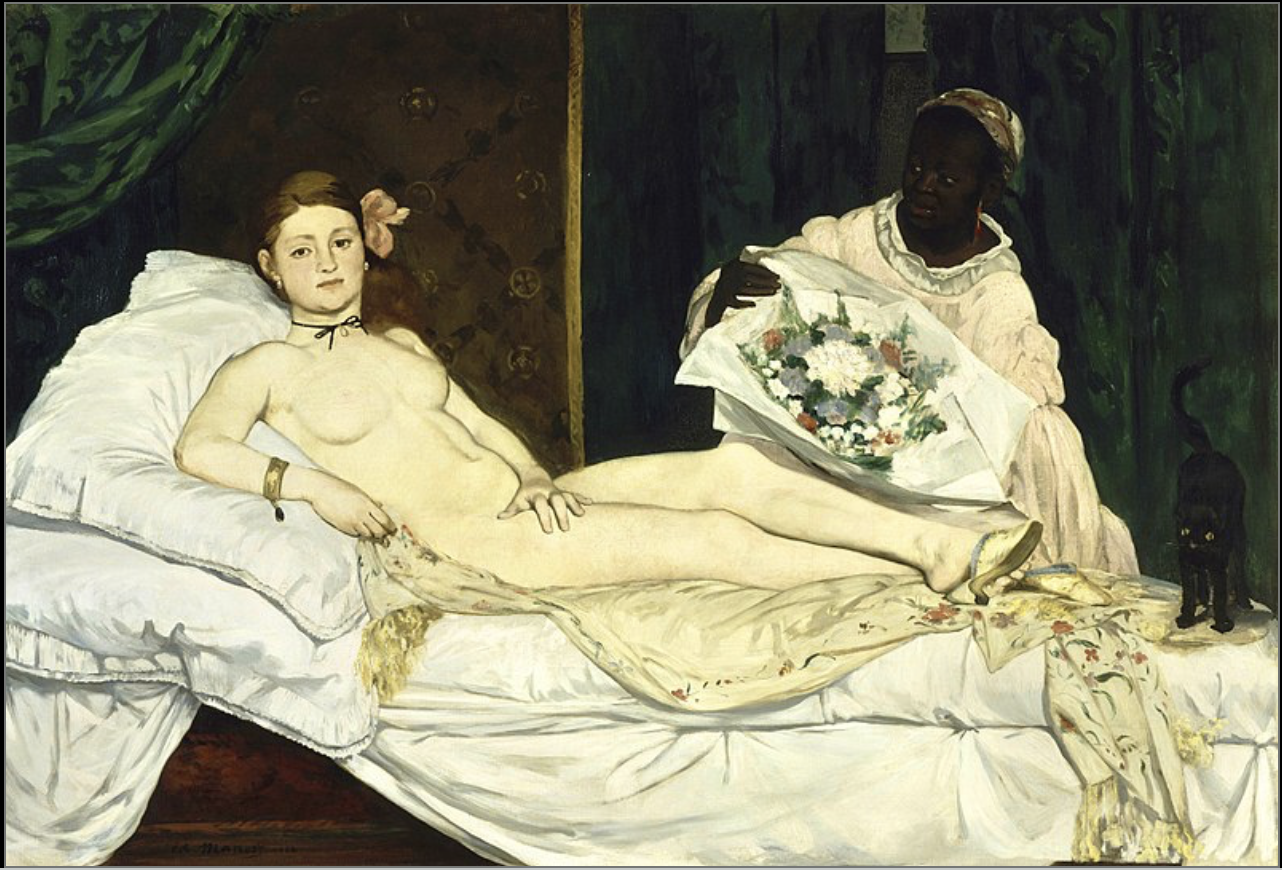
Édouard Manet, Olympia, 1863. Oil on canvas, 130.5 × 190 cm. Musée d’Orsay, Paris.
Introduction to the topic
This lesson explores the painted nude in nineteenth-century France as a site of aesthetic ambition, moral anxiety, and social contestation. We will emphasize how paintings had the power not just to offend aesthetes but, in the eyes of their contemporaries, to threaten entire social systems. While the nude was a long-established genre in Western art, by the nineteenth century it was volatile. The arena through which ideal beauty was debated, artistic prowess measured, and conventions for gendered representation urgently policed, a nude could sink or launch an artist’s reputation, galvanize the public and the censors, and generally cause shock waves difficult for seasoned museum-goers to understand.
In academic painting, the nude remained among the highest tests of artistic skill and its representation was the staple of the École des Beaux-Arts curriculum. In the hands of Academicians, the female nude embodied bodily perfection, beauty, and purity. “She” was understood as spurring the viewer (typically understood as male) to contemplation of ideal form, removed from the bodily realm of base appetites and desires. This was a mythology, of course, and one that was increasingly hard to uphold as the nineteenth century wore on. It collapsed in the hands of modern-life painters like Manet and the French impressionists. In their works, the nude was an arena for experimentation, reinvention, and what seemed to critics like transgression.
This session situates the nude within the structures of the French art world of the time. The official Salon and the Academy privileged history painting and upheld the classical ideal: the body was to be timeless, perfected, and morally sanitized. But painting modern life, understood along the lines of Baudelaire’s famous essay “The Painter of Modern Life,” put serious pressures on artists committed to painting their reality, who wished to publicly display paintings of unclothed contemporary subjects. Artists who dared to paint the nude in ways that refused idealization, or who brought the naked body into recognizably modern settings, found themselves at the center of scandal. This lesson examines how the nude functioned as far more than a formal or technical challenge, but as a potent cultural symbol through which anxieties about gender roles, sexuality, class, race, and national identity were expressed and negotiated.
The heart of the lesson is devoted to close reading of four key works: Manet’s Olympia, Degas’s Woman Bathing in a Shallow Tub, Caillebotte’s Young Man at His Bath, and Gauguin’s Spirit of the Dead Watching (Manao Tupapau). Each of these provoked controversy in its time, and each helps illuminate how the nude could be used to challenge norms and unsettle expectations. Through these examples, we will explore how artists manipulated subject matter, pose, style, color, composition, and perspective to reinforce, challenge, or disrupt the conventions of the genre. Alongside visual analysis, we will draw from nineteenth-century critical responses as well as art historical scholarship that assesses the role of the nude in constructing notions of identity, respectability, and power.
DELIVERY SUGGESTIONS
I communicate the importance of this material by framing the painted nude as a lens through which the social and political anxieties of modern France were negotiated—and through which similar issues persist today. I emphasize that these paintings were not simply aesthetic objects but actors in debates about modern life, and that the controversies that they provoked raise enduring questions about representation, vision, and power. Connecting these artworks to current conversations around the gaze and the ethics of display underscores their continued relevance.
The primary challenge students encounter with this material is difficulty understanding why these nudes were so controversial in their time. Not only are they familiar with twentieth-century art with far greater shock value, they are also accustomed to graphic, explicit imagery of bodies in highly realistic media, including cinema, advertising, and pornography. It is necessary therefore to help students develop a “period eye” through teaching historical background, analysing nineteenth-century reception including reviews and caricatures, and comparing modernist nudes with Academic examples.
There is a clear historiographical arc to this topic. For much of the twentieth century, the nude was taught within a formalist tradition which focused on beauty, proportion, and classical lineage while bracketing questions of gender, sexuality, race, and power. This has shifted dramatically since the 1980s with the rise of Marxist, feminist, postcolonial, and queer art histories. Scholars like Nead, Clark, Pollock, and Solomon-Godeau reframed the nude as a site of ideological production. The historiography can, for more advanced students, be a key part of the lesson. Students can compare, for example, how Olympia is read in Clark (class), Pollock (gender and race), and Getsy (transgender studies).
Ideas for pre-class activities:
- Students select a nude figure from a painting and write a 300-word purely formal analysis, addressing such aspects as composition, pose, perspective, line, color, style, and technique. Ask them to revisit that figure after reading contextual sources (e.g., Pollock or Grigsby on Laure, Manet’s Black model) to consider how meaning shifts.
Ideas for in-class activities:
- Present students with two nudes and have them compare form, style, mode of address, and message.
- Divide students into groups focused on distinct lenses—such as gender, race, and class—and have them analyse a nude through it.
- Assign students historical roles (eg Salon juror, academic painter, feminist activist, medical professional, working-class woman) and have them debate the exhibition of Olympia at the 1865 Salon.
Ideas for post-class activities:
- Using virtual museum tools (eg Musée d’Orsay’s or the Metropolitan Museum of Art’s online collection) have students create digital “wall texts” to accompany a nude of their choosing.
Modifications for level of course:
- Introductory: Focus on formal analysis, introducing core concepts (eg, gaze, genre, academic hierarchy, naked versus nude) with readings like the following. Focus on the juxtaposition of academic nudes with Manet’s Olympia and Degas’s bathers, leaving out Caillebotte and Gauguin.
- Kenneth Clark, “The Naked and the Nude,” pp. 3-29.
- Linda Nead, “Introduction” and “Theorizing the Female Nude”, pp. 1-33.
- John Berger, Chapters 2 and 3, pp. 36-64.
- Intermediate: Integrate more social history, assigning paired readings and asking students to debate differing interpretations. Good pairings are:
- T. J. Clark, “Olympia’s Choice,” with either Lorraine O’Grady, “Olympia’s Maid: Reclaiming Black Female Subjectivity” or Griselda Pollock, “A Tale of Three Women: Seeing in the Dark, Seeing Double, at Least, with Manet.”
- Tamar Garb, “Gustave Caillebotte’s Male Figures: Masculinity, Muscularity and Modernity” and Norma Broude, “Outing Impressionism: Homosexuality and Homosocial Bonding in the Work of Caillebotte and Bazille.”
- Advanced: Engage with primary sources and emphasize methodological developments in art history, which can be traced through responses to Manet’s Olympia (eg Zola and formalism, Clark and social history, Pollock and feminism, Grigsby and critical race theory, Getsy and transgender studies). Good primary sources are:
- William-Adolphe Bougoureau, “Address to the Institut de France,” 9-10.
- Jules-Antoine Castagnary, “A Critique of Three Venuses,” 14-15.
- Emile Zola, “A New Style in Painting,” 76-77, and “Adverse Criticisms of Manet,” 81-82.
- Paul Gauguin, “A Letter to his Wife about Spirit of the Dead Watches,” 168-169.
AT THE END OF CLASS…
Key Takeaways
- The painted nude was not neutral. It was a highly charged cultural form through which we can decipher values and hierarchies.
- Academic ideals were challenged by painters like Manet, Degas, Caillebotte, and Gauguin, who introduced new forms of realism, ambiguity, and confrontation that made the nude socio-politically volatile.
- The nude provoked scandal, not for nudity per se, but for bringing the naked body into recognizably modern contexts in styles that perplexed and angered viewers.
- Power is central. The genre raises enduring questions about who gets to look, who is looked at, and how representation is embedded in material realities.
- Historiography matters. Interpretations of these works have changed significantly over time.
- Questions raised by these paintings around power relations, propriety, and visibility remain urgent today in museums, media, and popular culture.
Points for Further Discussion
- How should museums frame these images?
- What’s at stake in teaching or exhibiting historical nudes today?
- Are there modern equivalents to the nineteenth-century scandals around nudes that this lesson covers? What images today provoke similar anxieties, and what do those controversies tell us about their cultural contexts?